"How do I know you understand my market?" is a question every founder should ask an agency. You've spent years learning how your buyers think, what they call their problems and why they buy. An agency that emails them on your behalf has a few weeks.
The honest answer is that no agency understands your market on day one. What you can judge is how it plans to learn it, and whether it asks the right questions before claiming to. This post covers what that research should look like, a worked example of turning research into a message, what to watch for on a first call, how to brief an agency, the red flags and a short FAQ.
Understanding a market isn't the same as knowing an industry
Plenty of agencies will tell you they've "worked in your space". That can help, but it's a weak test. Two companies in the same industry can sell to different buyers, with different problems, at very different prices.
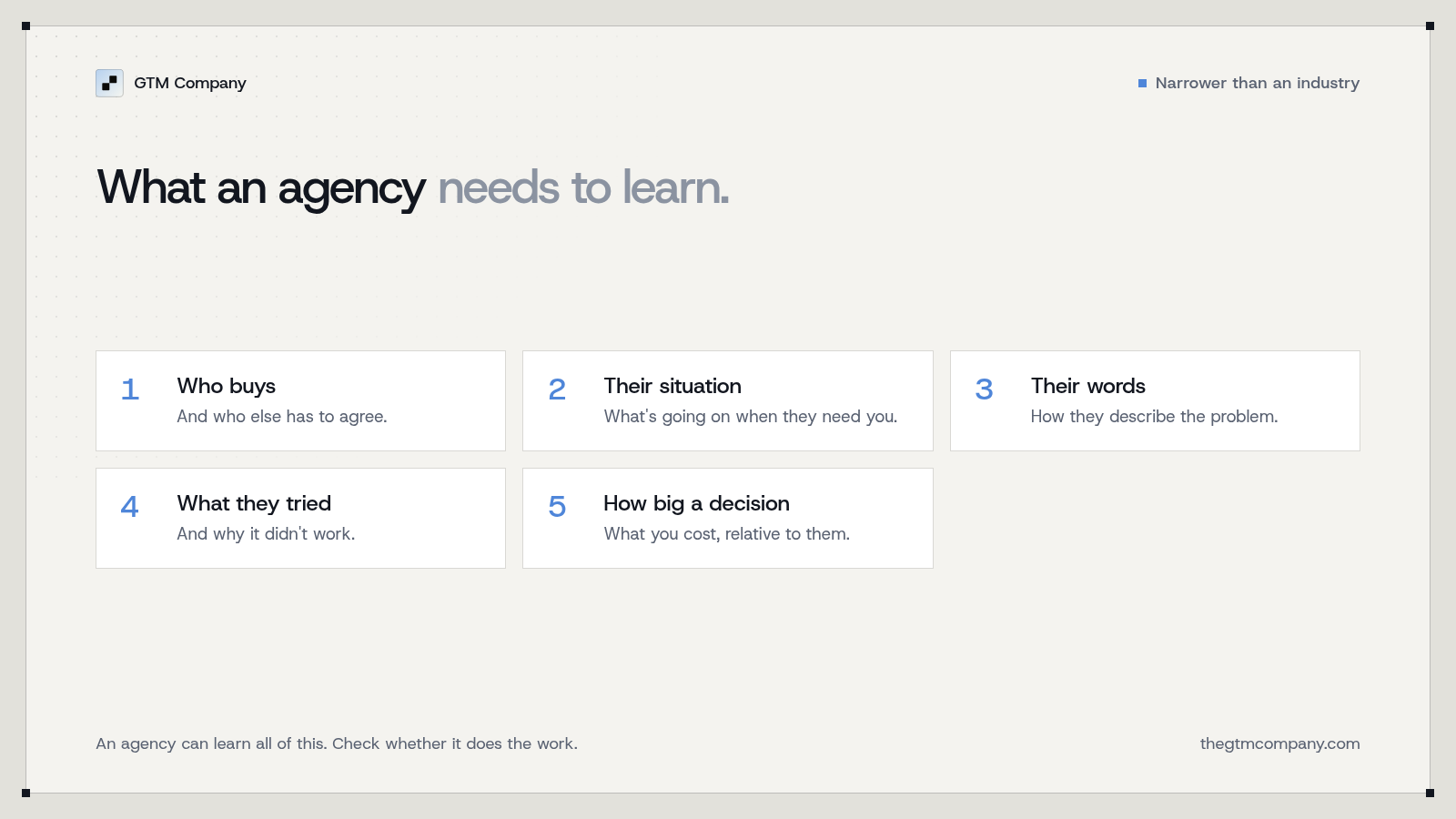
What matters for outbound is narrower:
- who buys, and who else has to agree
- what situation they're in when they need you
- the words they use to describe the problem
- what they've tried before, and why it didn't work
- what you cost, and how big a decision that is for them
An agency can learn all of that. The question is whether it does the work.
What proper market research looks like
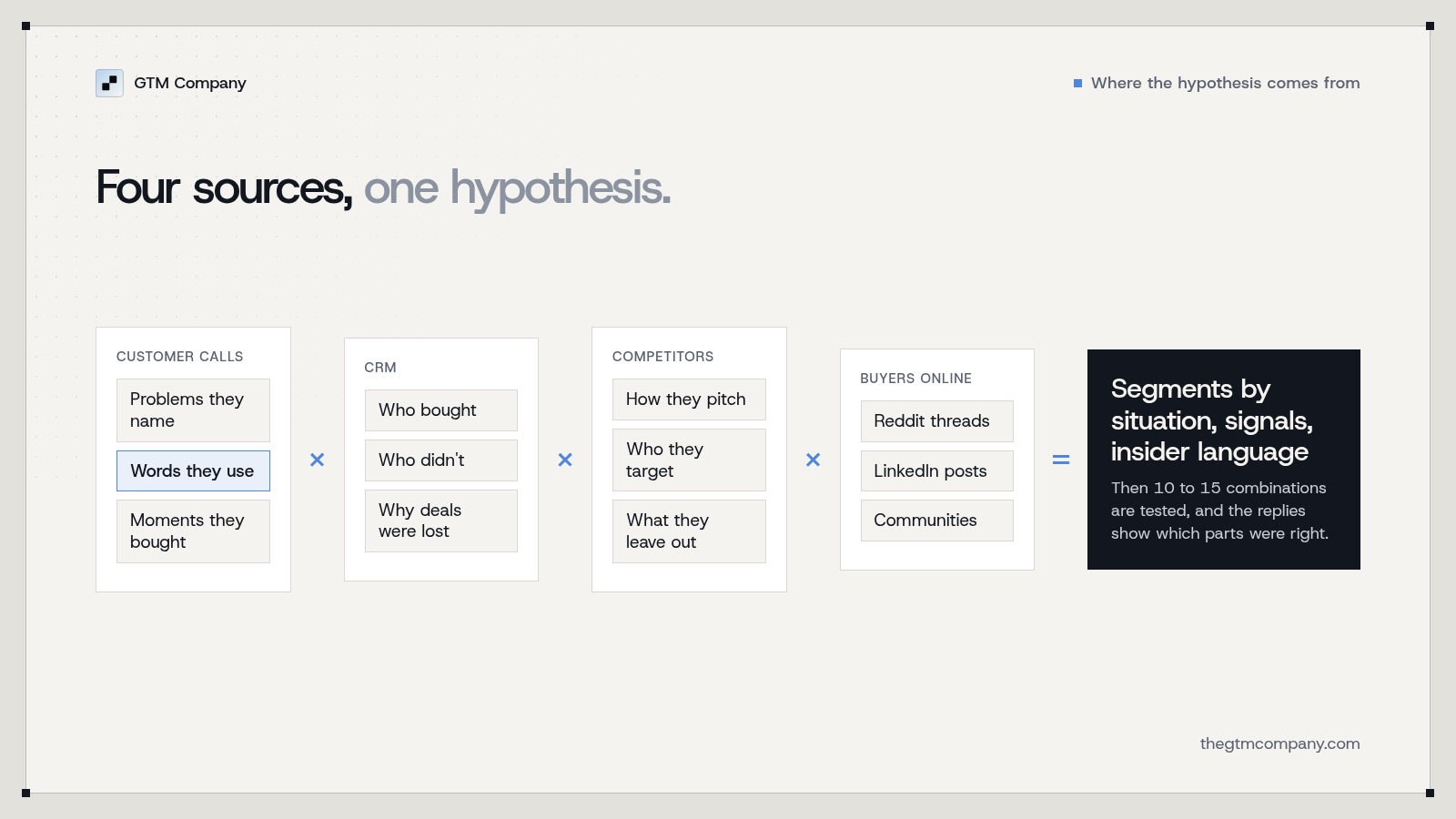
Before writing any copy, an agency should build a hypothesis about your market from real sources. These are the ones we use.
Your customer calls. In my opinion, recorded sales and customer calls are the best source of buyer language you have. We read them for the problems customers name, the words they use and the moments that made them buy.
Your CRM. Who bought, who didn't, how long it took and why deals were lost. Patterns here often show which segments are worth testing first.
Your competitors. How they describe the problem, who they target and what they leave out. Gaps are often where a message can stand out.
Buyer conversations online. Reddit threads, LinkedIn posts and community discussions where your buyers talk about their work in their own words.
From that, we build segments of companies that share a situation, look for signals that show a company is in that situation now, and write messages in the buyer's own language. Then we test 10 to 15 of those combinations and let the replies tell us which parts of the hypothesis were right.
A worked example: from research to a message
This example is made up to show the process. It isn't a client.
Say you sell scheduling software to multi-site physiotherapy clinics.
What the calls say. In onboarding calls, clinic owners keep describing the same moment: they opened a second or third site, and the front desk started double-booking therapists across locations. Nobody says "scheduling inefficiency". They say "we booked the same physio in two places on a Tuesday".
What the CRM says. Closed-won deals cluster around clinics with two to five sites. Single-site clinics take longer and churn more.
What competitors say. Most talk about "streamlining your practice". None mention the move from one site to several.
What buyers say online. Practice owners in community threads ask how other people manage rotas across sites.
The hypothesis. One segment is clinics that have just opened a second site. A signal could be a new location listed on their website or a job ad for a second-site receptionist. The message names the double-booking problem in the owner's words, and the offer is small: a short look at how other multi-site clinics handle it.
That's one combination. A proper test runs 10 to 15 of them at once, so the replies show which situation, signal and message actually land.
Why insider language matters
Your buyers get a lot of cold email. Most of it describes their problem the way a vendor would, in category words like "efficiency", "visibility" or "streamlining". It reads like everyone else's, so it gets ignored.
A message written in insider language reads differently. It uses the phrases buyers use with each other, names the moment they're in, and sounds like it came from someone who has sat in their meetings. That's hard to fake, and it's the clearest sign an agency has done the research. When you read draft copy, ask yourself: would one of my customers say it this way? If not, send it back.
Segments by situation, not only by industry
An industry list is a starting point, not a segment. "SaaS companies with 50 to 200 staff" contains businesses in completely different situations: some hiring fast, some cutting costs, some just raising, some about to switch tools.
A segment built on a shared situation groups companies that have the same problem right now. That makes the message easier to write, because one message can speak to all of them. It also makes the results easier to read, because if a segment replies, you know why.
A signal is optional. It's a sign a company is in that situation at the moment, such as a job ad, a new location or a funding round. Some segments don't have a clean signal, and that's fine.
Questions a good agency asks you
You can learn a lot from what an agency asks on the first call. Look for questions like:
- Who are your best customers, and what do they have in common?
- What was going on in their business when they bought?
- What's your ACV, and what's your close rate on a good call?
- Roughly how many companies could buy from you?
- What have you tried in outbound before, and what happened?
- Who else is involved in the decision on the buyer's side?
Notice what these have in common. They're about your buyer and your numbers, not about the agency's tools or how many emails it can send. An agency that spends the first call talking about its own sending infrastructure hasn't started learning your market yet. One that spends it asking about your customers has.
If an agency doesn't ask about your ACV or your market size, it can't tell whether outbound will pay back for you, or whether your market can take the volume.
Why early audits often miss
Some agencies send a free audit or a sample campaign before the first call, or straight after a short one. It looks generous, and it can be useful. It can also go wrong.
If the audit is built before anyone has confirmed who your buyer is and what you charge, it's built on a guess. We've seen audits made too early aimed at the wrong market entirely, or so generic the prospect assumed it was machine-written. That's why we only offer a research pack or audit after we've confirmed your ICP and ACV with you.
If you're sent an audit, check whether it describes your buyer the way you would. If it doesn't, ask how it was built and what it was based on. A good agency will be glad to explain, and to rebuild it once it knows more.
How to brief an agency so it learns faster
You can shorten the learning curve a lot. Before the research starts:
- Share five to ten recorded calls. A mix of won deals, lost deals and onboarding.
- Export closed-won and closed-lost deals from your CRM, with notes if you have them.
- Name your three best customers and say why they're the best.
- List the competitors your buyers mention.
- Write down the words you'd never use in your messaging, and the claims you can't make.
- Say who approves copy, and how quickly.
The more of this an agency has, the closer its first hypothesis will be. It still needs testing, but it starts from your buyers rather than from a template.
Signs an agency will get your market
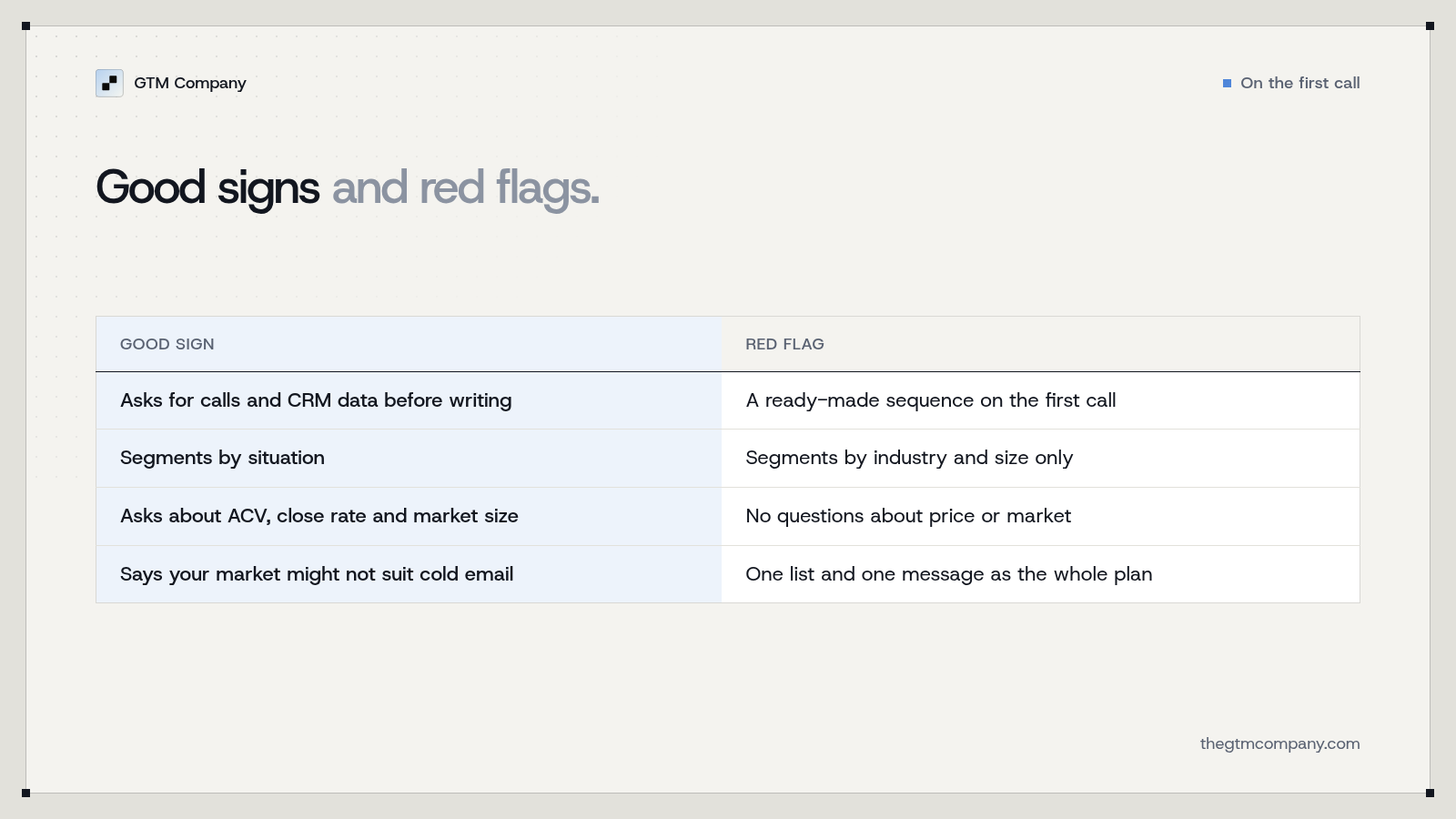
- They ask for your customer calls and CRM data before writing anything.
- They talk about segments by situation, not only by industry and company size.
- They can explain how they'll know if their first guess was wrong.
- They're willing to say your market might not suit cold email.
Red flags
- A ready-made sequence on the first call, before they know your buyer.
- Claims to know your market based only on having worked in your industry.
- No questions about price, close rate or market size.
- One list and one message as the whole plan. Every cold email agency sounds the same covers more questions to ask.
Common mistakes founders make
Judging on industry experience alone. It's the easiest thing to check and the least useful on its own.
Withholding the calls. Founders sometimes hold back recordings because they feel messy. Messy is fine. That's where the buyer's own words are.
Rewriting the copy into your own language. If buyers say "double-booked" and your copy says "scheduling optimisation", the insider language is lost. Push back on jargon, including your own.
Expecting the first guess to be right. The first hypothesis is meant to be tested. Ask how the agency will know which parts were wrong.
FAQ
Should the agency have worked in my industry before? It helps a little. The research process matters more.
How long does the research take? In our process, research sits in the first few days of onboarding, before the strategy call.
What if my market is very technical? Then the calls matter even more. Technical buyers notice quickly when a message gets their terms wrong.
Can I see the research before anything is sent? You should. Segments, signals and offers are agreed on the strategy call, and you approve the copy before it goes out.
Research at scale
Understanding a market also means finding everyone in it. For one AI customer support client, we mapped 240,000 SaaS founders from 10 data providers and scored each by fit. That gave the testing room to run: they went on to more than 320 experiments with us and 435 demos booked.
Test us on it
Bring a description of your best customer to a call and ask us how we'd research your market. We'll ask the questions above, and if we don't think cold email suits your market, we'll tell you. Book at thegtmcompany.com.