If you sell to a niche, you've probably wondered whether cold email can work for you at all. It's a good question to ask early, because in a small market a bad campaign doesn't only waste money. It uses up people you can't easily replace.
This post covers how to count your market properly, the thresholds we use, and how to approach outbound if your market is on the small side. There's a worked example of how quickly a test uses up a small market, a step-by-step count, the common mistakes, and a short FAQ.
Why market size matters more for cold email than other channels
Cold email works by testing. You try combinations of segment, signal and message, read what comes back, and keep what works. To call a combination a winner, we want to see it hold up across about 10,000 emails to a segment.
That needs people to send to. If your whole market is a few thousand companies, there isn't room to test many ideas before you've contacted most of them. Each miss also leaves a company that has seen a weak email from you, and that's harder to undo in a small market where people know each other.
The thresholds we use
These are the rules we apply to B2B SaaS companies before taking on outbound work:
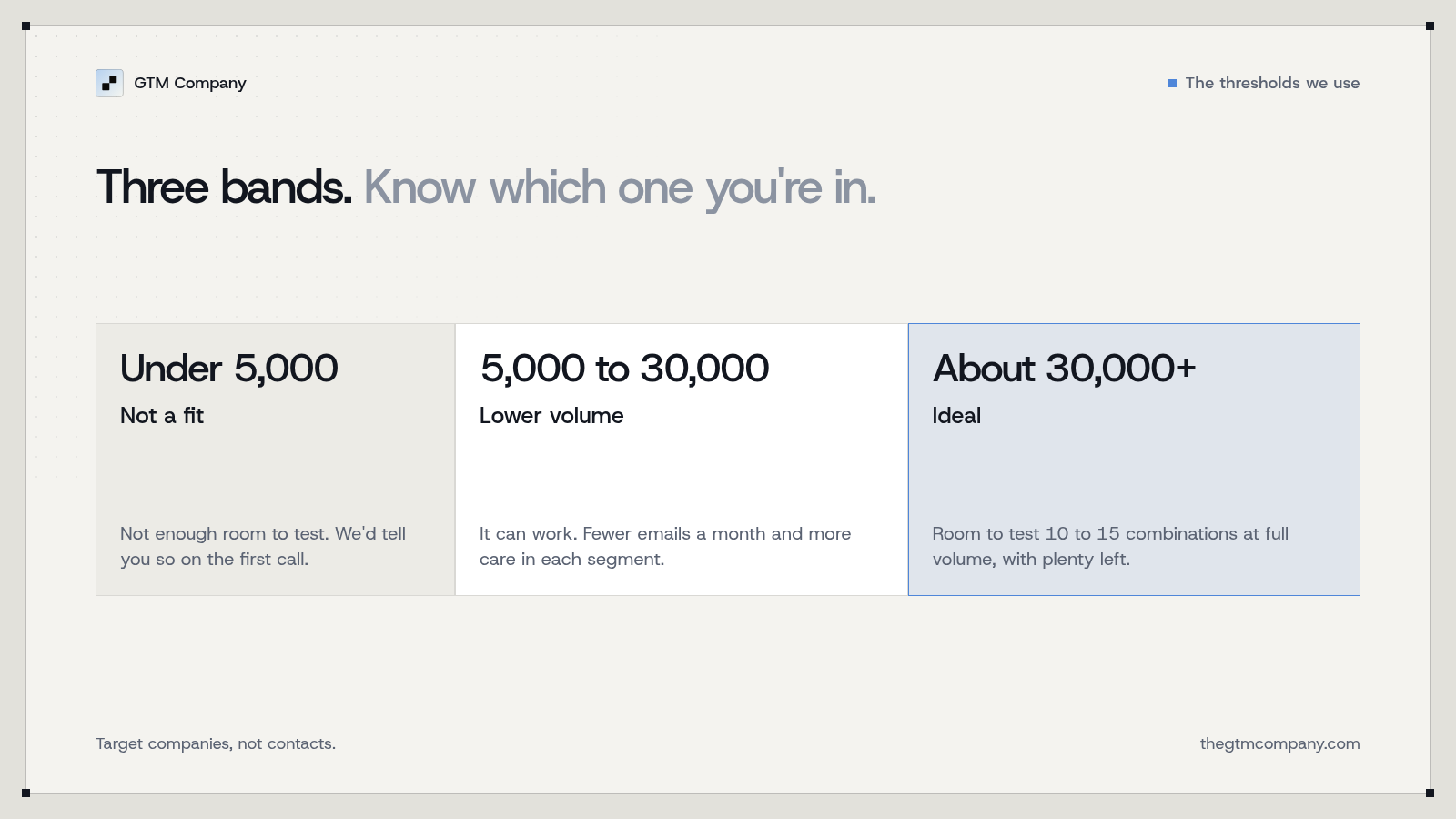
- Under 5,000 target companies: we don't recommend a cold email programme of the kind we run. There usually isn't enough room to test, and we'd tell you so on the first call.
- 5,000 to 30,000 target companies: cold email can work, but volume should be lower so the market isn't burned. Fewer emails a month, more care in each segment.
- Around 30,000 or more: this is the ideal range. There's room to test 10 to 15 combinations at full volume and still have plenty of market left once a winner is found.
These are companies, not contacts. A market of 6,000 companies with three relevant people at each gives you more people to reach, but the same number of businesses that can buy.
A worked example: how fast a test uses up a market
This is an example, not a client's market. The sum shows why the bands sit where they do.
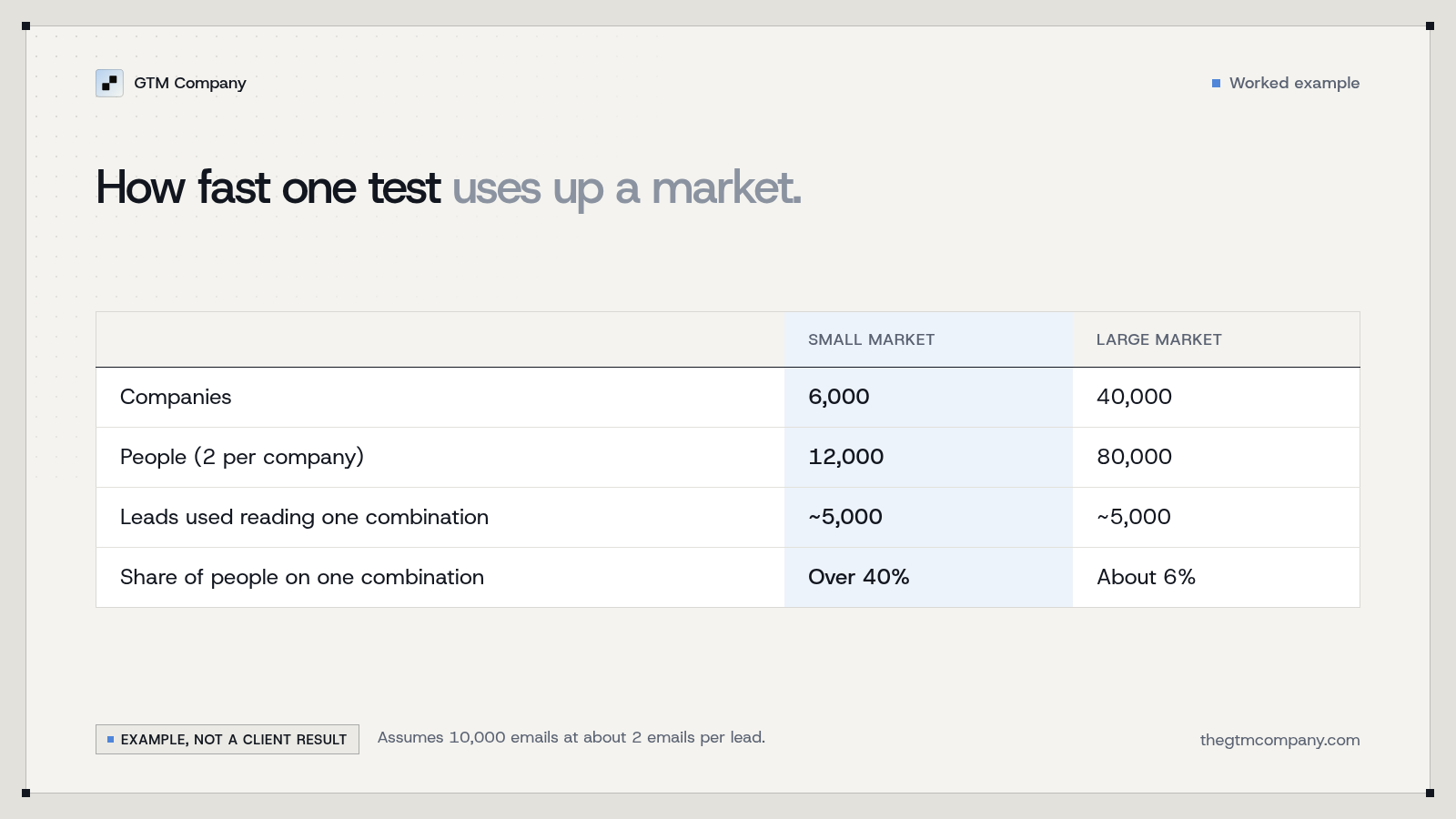
- Say your market is 6,000 companies, with two relevant people at each. That's 12,000 people.
- Each lead usually gets more than one email in a sequence. Assume about two emails per lead.
- Reading one combination across 10,000 emails then uses about 5,000 leads.
- That's over 40% of your people on a single combination.
Run three or four combinations and you've contacted most of the market before anything has been proven. Now do the same sum for 40,000 companies with two people at each: one combination uses about 6% of the market, and you can test 10 to 15 with plenty left over.
How to count your market
A rough count is enough to know which band you're in. This is a simple way to get one.
- List your best customers. Pick the 10 to 20 who bought fastest and stayed longest.
- Write down what they have in common. Industry, size, location, the tools they use, how they're structured, and the situation they were in when they bought.
- Turn that into filters. Most data providers let you filter by industry, headcount, region and technology. Build the filter from your list, not from a guess.
- Count the result. That number is your starting market. Then sense-check it: remove companies you'd never sell to, and add adjacent segments you know buy.
- Count the adjacent segments separately. Markets often look small because they've been defined as one segment. Two or three neighbouring segments with the same problem can move you into a different band.
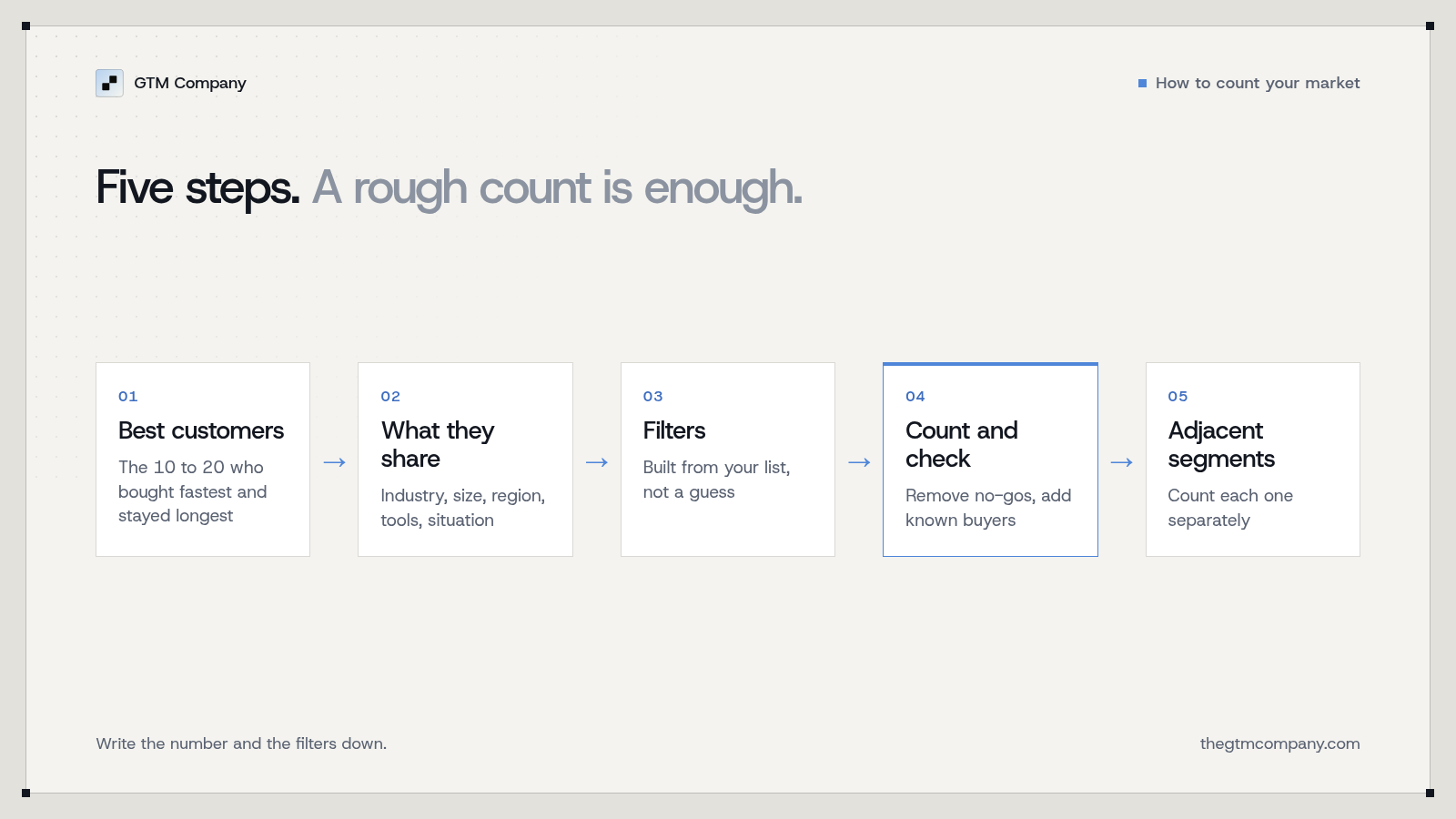
Write the number down, along with the filters you used, so you can repeat the count later as your product or market changes.
Build the count from more than one data source if you can. Different providers cover different parts of a market. For one AI customer support client, we mapped 240,000 SaaS founders from 10 data providers and scored each one by fit.
A worked example of finding the hidden segments
This is an example, not a client story. Say you sell scheduling software to commercial cleaning companies, and your first count comes out at 4,000 companies in your region. On the thresholds above, that's below the line.
Before deciding, look at who else has the same problem. Your product solves shift cover across many sites with a mobile workforce. So does:
- facilities management firms running cleaning and maintenance contracts
- security companies covering sites around the clock
- home care providers scheduling visits across a patch
- event staffing agencies filling short-notice shifts
Count each one separately with the same care. If two or three of them come out at several thousand companies each, your combined market may sit in the middle band or above. Each one also becomes its own segment, with its own message about its own version of the problem. That's what you'd want to test anyway.
If the neighbouring segments turn out to be small too, or don't share the problem, you've learned something important cheaply. Cold email isn't your channel yet, and you haven't spent a penny on sending to find that out.
Why signals matter more in a small market
In a big market you can afford to test broadly and narrow down. In a small one, every email needs a reason to exist. Signals help you send fewer, better-timed emails.
Useful signals are things that show a company is in the situation your product helps with right now: a new site opened, a new contract won, a role advertised, a tool replaced, a regulation that has just changed. Where you can find a signal, send only to the companies showing it, and hold the rest of the market back until you know what works.
Before your first send in a small market
Answer these first:
- What's our company count, and which band is it in?
- Which adjacent segments did we count, and which did we rule out?
- What's our do-not-contact list, and is it loaded?
- How many emails a month can the market take without burning it?
- Which accounts are we holding back until we have a proven message?
Niche doesn't always mean small
Founders who describe their market as niche often mean the problem is specific, not that the number of companies is low. A product built for one type of team inside one type of company can still have tens of thousands of companies to sell to.
The specific problem is often an advantage. A message written in your buyer's words, about a problem only they have, tends to land better than a broad one. Splitting your market into segments that share a situation is how good cold email works anyway.
How to test a market in the middle band
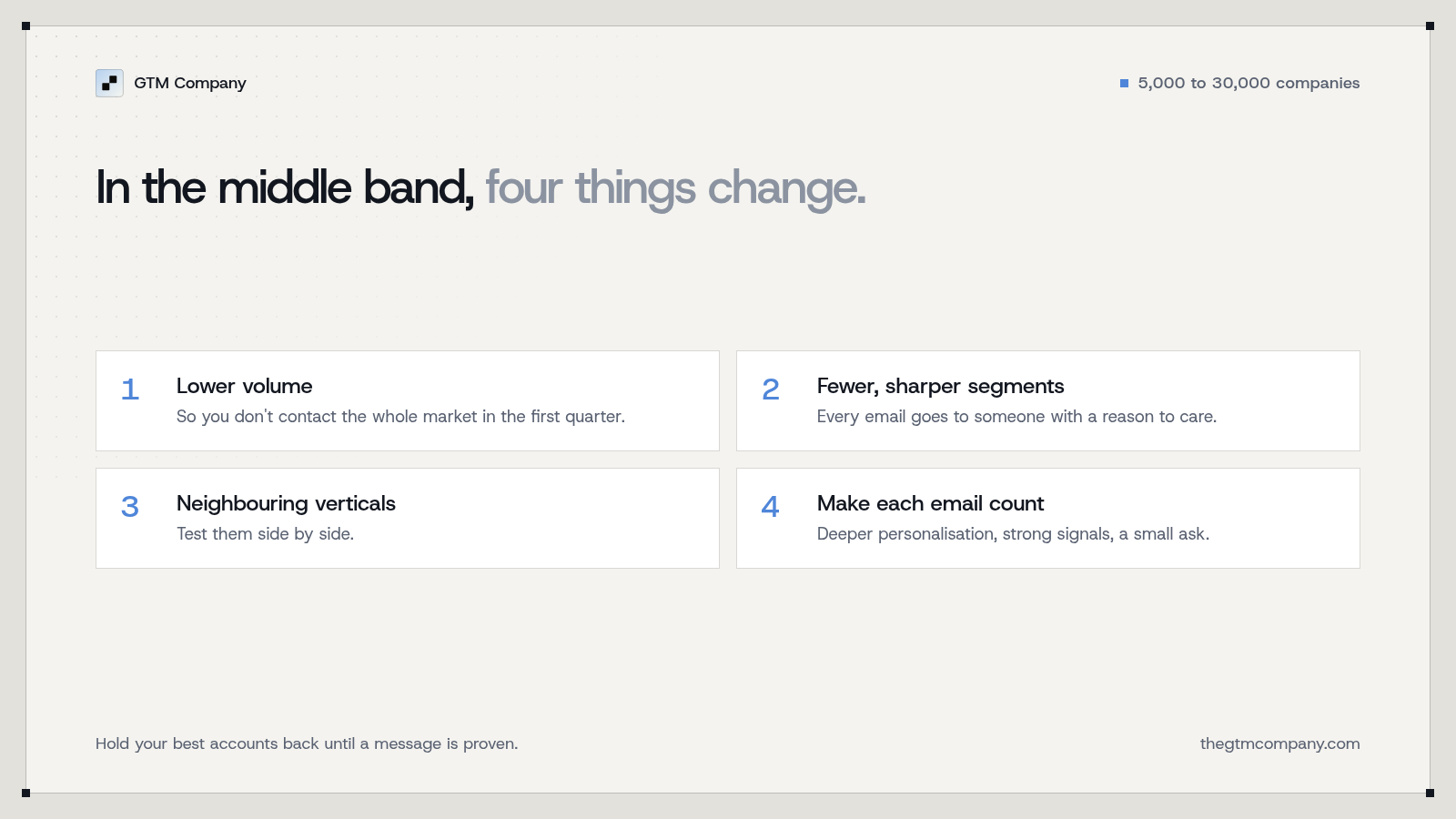
If your count lands between 5,000 and 30,000 companies, cold email can still work. A few things change.
Lower volume. Send fewer emails a month so you don't contact the whole market in the first quarter.
Fewer, sharper segments. Test a smaller number of segments, each defined tightly, so every email goes to someone with a reason to care.
Test more than one vertical at a time. If your product sells into several neighbouring industries, test them side by side. One UK sustainability platform we worked with tested three verticals at once and reached 40 booked calls a month.
Make each email count. Personalise more deeply, lean on signals that show a company is in the right situation now, and keep the ask small.
Common mistakes when sizing a market
Counting contacts instead of companies. Contacts inflate the number. Companies are what buy, and what you can burn.
Counting from a guess. Build the filters from your best customers, not from the market you'd like to have.
Using one data source. Each provider misses part of a market. Two or three sources give a truer count.
Defining the market as one segment. Neighbouring segments with the same problem may double or triple your count.
Forgetting your existing customers and open deals. Take them out of the number. You shouldn't be cold emailing them.
Treating the count as fixed. New product lines, regions or segments change it. Recount once or twice a year.
FAQ
What if I'm near 5,000? Bring the number and the filters to a call. A market near the line can sometimes grow by adding adjacent segments, and sometimes can't.
Can I email more than one person at each company? Yes, and it's often sensible. It doesn't change how many companies can buy, so use the company count to decide which band you're in.
Does a high ACV make up for a small market? It improves the payback, but it doesn't create more companies to test on. In a very small, high-value market, account-based work may suit you better.
How many emails a month is safe in the middle band? There isn't one number. Work back from the market: decide what share of it you're willing to contact in the first quarter, and set the volume from that.
What if the market is big but my best customers are a small slice of it? Count the slice. That's where your first segments will come from, and the rest of the market can be tested once you have a proven message.
Is a burned market permanent? Not usually, but people remember a poor email in a small market. It's much easier to avoid than to repair.
What about markets outside the UK and US? Count them the same way. Data coverage varies by country, so expect to use more sources.
When cold email isn't the right channel
If your market is under 5,000 companies, or very concentrated in a small number of big accounts, other approaches may be a better use of money. Account-based work, partnerships, events and founder-led selling can reach a small market more carefully than volume email.
We'd rather tell you that at the start than take on work that can't succeed. If market size isn't the issue but you're still not sure outbound can earn its cost, will outbound pay back covers the maths.
Check your number with us
If you've done the count and you're not sure which band you're in, bring the number to a call. We'll check it with you and give you a straight answer on whether cold email makes sense. Book at thegtmcompany.com.