If you've paid for outbound before and got nothing back, "will it pay back?" is the right question to ask. A cold email ROI model won't give you a guaranteed answer. It will show you which numbers decide the answer, which of them you already know, and which ones only testing can tell you.
This post builds that model step by step, with a worked example, a way to stress-test it, the mistakes that make models lie, and what to check by month three. If you only want the quick version (total commitment divided by ACV), start with is a $5K a month cold email agency worth it.
The five links in the chain
Every outbound channel turns sends into revenue through the same chain:
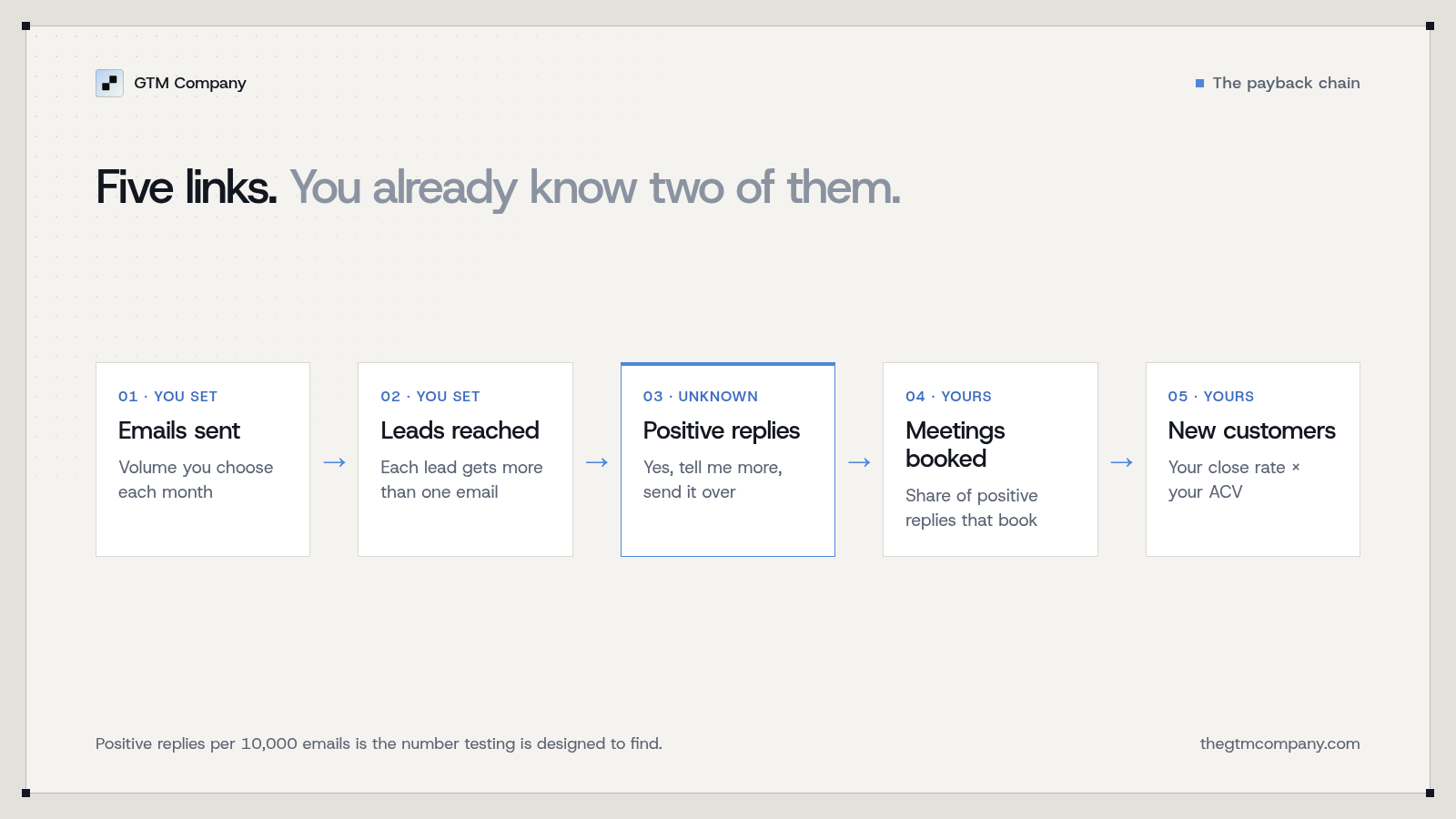
- Emails sent each month
- Leads reached, since each lead gets more than one email in a sequence
- Positive replies, meaning people who say yes, tell me more, or send it over
- Meetings booked from those replies
- New customers from those meetings, at your ACV
You know the last two links better than any agency. You know your close rate on a good call and what a customer pays. The middle links are the unknown part, and they're the reason outbound is hard to forecast before you've found a message that works.
That split matters for how you read any model, including one an agency shows you. The links you know should come from your own data. The links you don't know should be shown as a range, never as a single confident number.
A worked example
Here is the model with illustrative numbers. Replace every assumption with your own.
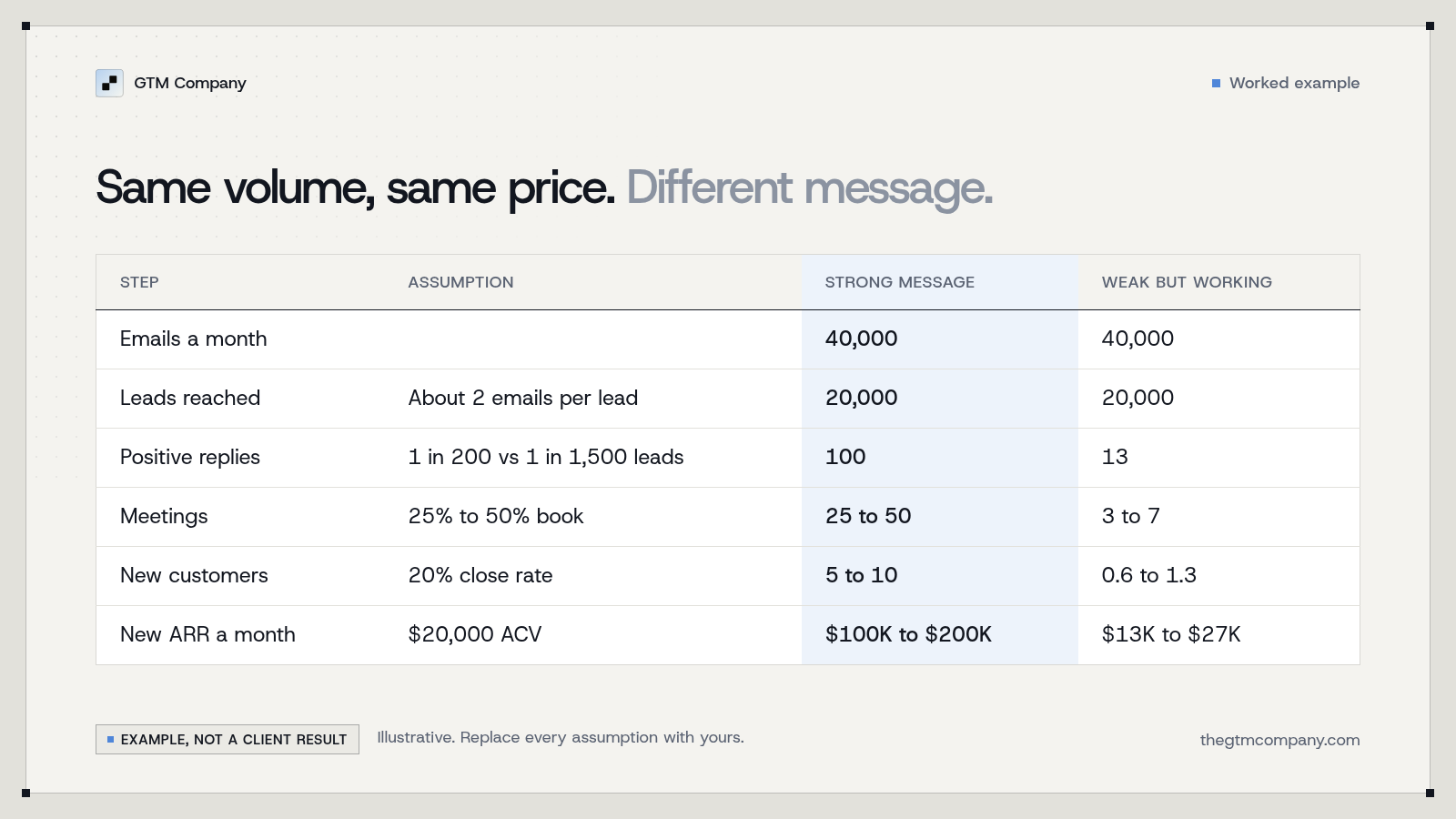
| Step | Assumption | Strong message | Weak but working message |
|---|---|---|---|
| Emails a month | 40,000 | 40,000 | |
| Leads reached | About 2 emails per lead | 20,000 | 20,000 |
| Positive replies | 1 in 200 leads vs 1 in 1,500 | 100 | 13 |
| Meetings | 25% to 50% of positive replies book | 25 to 50 | 3 to 7 |
| New customers | 20% close rate | 5 to 10 | 0.6 to 1.3 |
| New ARR a month | $20,000 ACV | $100,000 to $200,000 | $13,000 to $27,000 |
The positive-reply range in that table is the range we work to. A winning combination for one client might return 1 positive reply in every 200 leads, and for another 1 in every 1,500. Both can be winners. What makes a combination a winner is that the result repeats.
The booking and close rates are placeholders. Yours might be higher or lower, and you should use your own.
What the example teaches
The message is the biggest lever in the model. The gap between the strong and the weak column is close to eight times on positive replies, with the same volume, the same list size and the same price. Nothing else in the chain moves the result that much.
Even a weak but working message can pay back. At a $20,000 ACV, the weak column still adds $13,000 to $27,000 of new ARR a month. Run the same column at a $2,000 ACV and it adds $1,300 to $2,700, which won't cover the cost of most agencies. That's why the ACV floor matters so much.
Before you've found the message, you can't fill in the table. If your pipeline arrives from referrals when it arrives, you probably can't say what a new customer costs you to win. The point of finding message-market fit is to turn the middle of this table into numbers you can plan around.
Build the model yourself, step by step
You don't need an agency to do this. Open a spreadsheet and put one row per link in the chain.
Step 1: enter what you know. Your first-year ACV and your close rate on good-fit sales calls. Take both from your last few months of deals, not from your plan. If you only have a handful of deals, use the lower end of what you've seen.
Step 2: set the volume. Put in the number of emails a month you're considering. Divide by the number of emails each lead receives in a sequence to get leads reached. About two emails per lead is the assumption in the example above. Your sequence might be longer or shorter.
Step 3: run three positive-reply scenarios. Use 1 in 200, 1 in 700 and 1 in 1,500 leads. The first and last are the ends of the range a winning combination falls in. The middle one is a placeholder so you can see the shape of the curve.
Step 4: try two booking rates. Use 25% and 50% of positive replies booking a meeting. If you already run outbound and know your own figure, use that instead.
Step 5: apply your close rate and ACV. That gives you new customers and new ARR a month for each scenario.
Step 6: put the monthly cost next to each row. Include the agency fee and any tools or data you'd pay for on top.
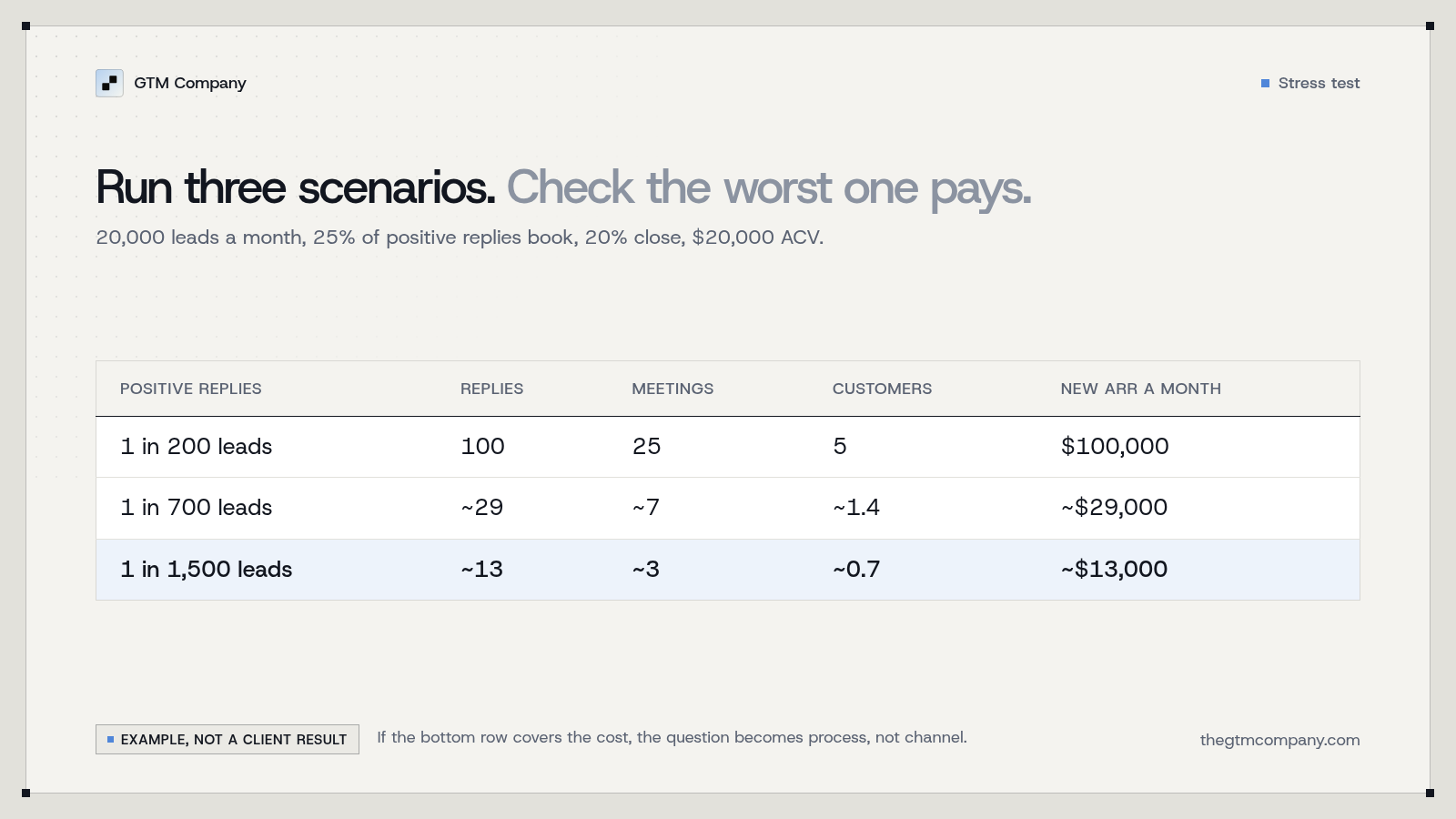
At 20,000 leads a month, a 25% booking rate, a 20% close rate and a $20,000 ACV, the three scenarios come out roughly like this. These are example numbers, not a forecast:
| Positive replies | Replies | Meetings | Customers | New ARR a month |
|---|---|---|---|---|
| 1 in 200 leads | 100 | 25 | 5 | $100,000 |
| 1 in 700 leads | about 29 | about 7 | about 1.4 | about $29,000 |
| 1 in 1,500 leads | about 13 | about 3 | about 0.7 | about $13,000 |
How to read the result
If only the most optimistic row pays back, the risk is high. You're betting on finding a strong message, and you should know that going in.
If the worst row still covers the cost, the question is no longer whether outbound can pay back. It's whether the agency can find a combination in the range. That's a question about process, and you can test an agency on it. I've written seven questions for that in how to choose a cold email agency.
If none of the rows pay back, look at your ACV first. Below about $5,000, most done-for-you outbound struggles to repay. Then look at your close rate. A low close rate on good-fit calls is a sales problem, and outbound will magnify it.
Common mistakes that make a payback model lie
Using one number for reply rate. A single figure, especially one taken from someone else's case study, hides the thing you most need to know: how wide the range is. Always model a range.
Borrowing your referral close rate. People introduced by a friend arrive half-sold. People who answered a cold email don't. In my experience outbound meetings close lower, so start lower.
Counting all replies, not positive ones. "Not interested" and "take me off your list" are replies. They don't belong in the model.
Leaving out the sales cycle. If deals take 60 days to close, revenue from a meeting booked in month two lands in month four. A model that expects revenue in the same month as the meeting will look like a failure early on.
Leaving out your own time. Someone has to take the meetings. If that's you, those hours are a cost. If the alternative is you sending the emails as well, that's a bigger cost.
Presenting a model before the inputs are confirmed. A model built on a guessed ACV can get the ROI badly wrong in either direction. Confirm the inputs first, then build.
The three places payback breaks
When outbound fails to pay back, it's usually one of these.
Plenty of replies, few meetings. A strong interested-reply rate can sit alongside a weak booking rate. The offer gets attention but doesn't earn the call. The fix is in the offer and the reply handling, not the volume.
Meetings that don't close. If the meetings are with the wrong people, the close rate collapses. This is the main risk with anything paid per meeting (I've written about that in pay-per-meeting lead generation).
Judging revenue too early. If your sales cycle runs 60 days, a meeting booked in month two may not close until month four. Month-three revenue will understate what the channel is doing.
What to look for by month three
Because revenue lags, set the checkpoints for month three on the links you can see.
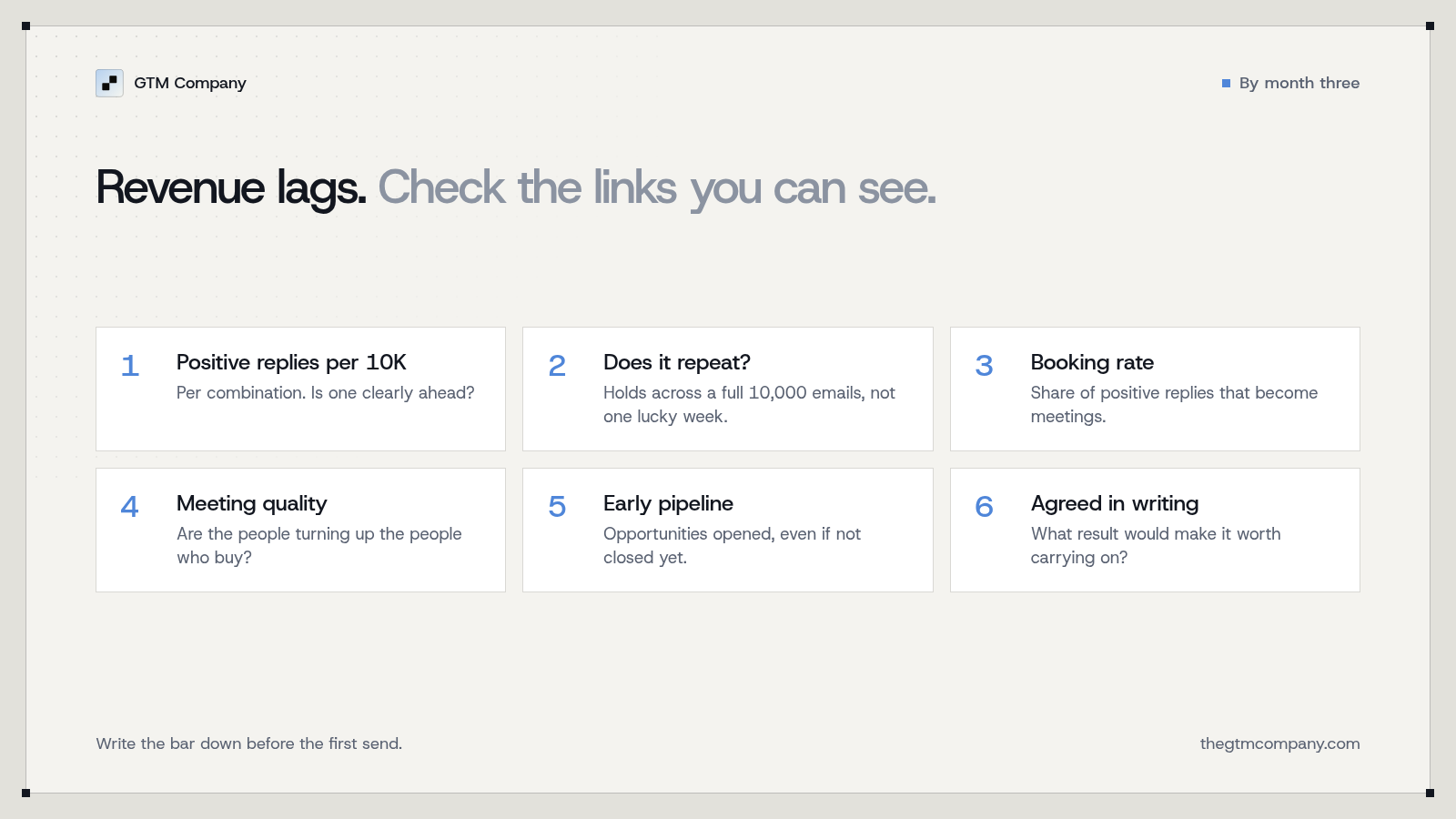
- Positive replies per 10,000 emails, per combination. Is one combination clearly ahead?
- Does it repeat? Does the leading combination hold its rate across a full 10,000 emails, or was it a lucky week?
- Booking rate. What share of positive replies turn into meetings?
- Meeting quality. Are the people turning up the people who buy from you?
- Early pipeline. Opportunities opened, even if they haven't closed.
Write down before you start what result on those numbers would make it worth carrying on. If an agency won't agree to measure itself this way, ask why.
A good weekly report makes this easy. Ours goes out on Fridays and covers outliers, reply sentiment, bookings and a decision for each combination: keep it, change it or kill it. By month three you should be able to look back over a dozen of those reports and see why the leading combination is leading.
A note on proof
Ask any agency for proof of return on investment, not activity. A cold outbound infrastructure client had hired at least two dozen agencies before us. Their founder's verdict was that we were one of two that had generated a positive ROI. That kind of comment is worth more than any reply-rate screenshot, and it's the bar to hold an agency to.
FAQ
What is a good cold email ROI? I'd judge it on first-year revenue against total cost. If new customers from the channel repay the commitment in their first year, it's working. Anything after that is upside.
What reply rate should I put in my model? Model positive replies, not all replies, and use a range. The combinations we call winners return somewhere between 1 positive reply in 200 leads and 1 in 1,500. Where you land depends on your market and your offer.
How long before outbound pays back? It depends on your sales cycle. Sends start about two weeks after kick-off because domains need warming, then you need meetings, then deals. Measure the leading numbers first and revenue once your normal cycle has had time to run.
Should an agency build this model for me? It can help, but only once your real ACV and close rate are on the table. A model on guessed inputs is worse than no model.
What if my co-founder wants to see the model? Good. Bring the worst-case row, not the best. I've written about making that case in how to get your co-founder or board to sign off on outbound.
Bring your numbers
If you'd like a second pair of eyes on your model, bring your ACV and close rate to a call. We'll build it with you on your real figures and tell you straight if it doesn't work. Book at thegtmcompany.com.