Five thousand dollars a month sounds like a lot when your pipeline still comes from referrals and your own network. For some companies it is too much. For others, a cold email agency at that cost works out as a cheap way to win customers.
The difference comes down to one number: your average contract value (ACV), meaning what a new customer pays you in a year. You can work out which group you're in with a calculator, before you speak to any agency, including us.
This post walks through that sum, the mistakes I see founders make when they run it, where the maths stops working, and what the fee should be buying in the first place. If you get to the end and the numbers don't add up for you, that's a useful answer too.
The sum to run: deals to repay
Most outbound agencies ask for a minimum commitment. Ours is three months. So the number to look at is the whole commitment, not the monthly fee, divided by what one new customer is worth to you in year one.
Deals to repay = total commitment ÷ your ACV
That's it. The answer tells you how many new customers the engagement has to produce before it has paid for itself. Below one, a single deal covers it. Above three, you're asking a lot of a channel you haven't proven yet.
To see how it works, say an agency quotes $15,000 for a three-month commitment. That figure is hypothetical, picked to make the sums easy, and it isn't our pricing. Here's what it takes to repay:
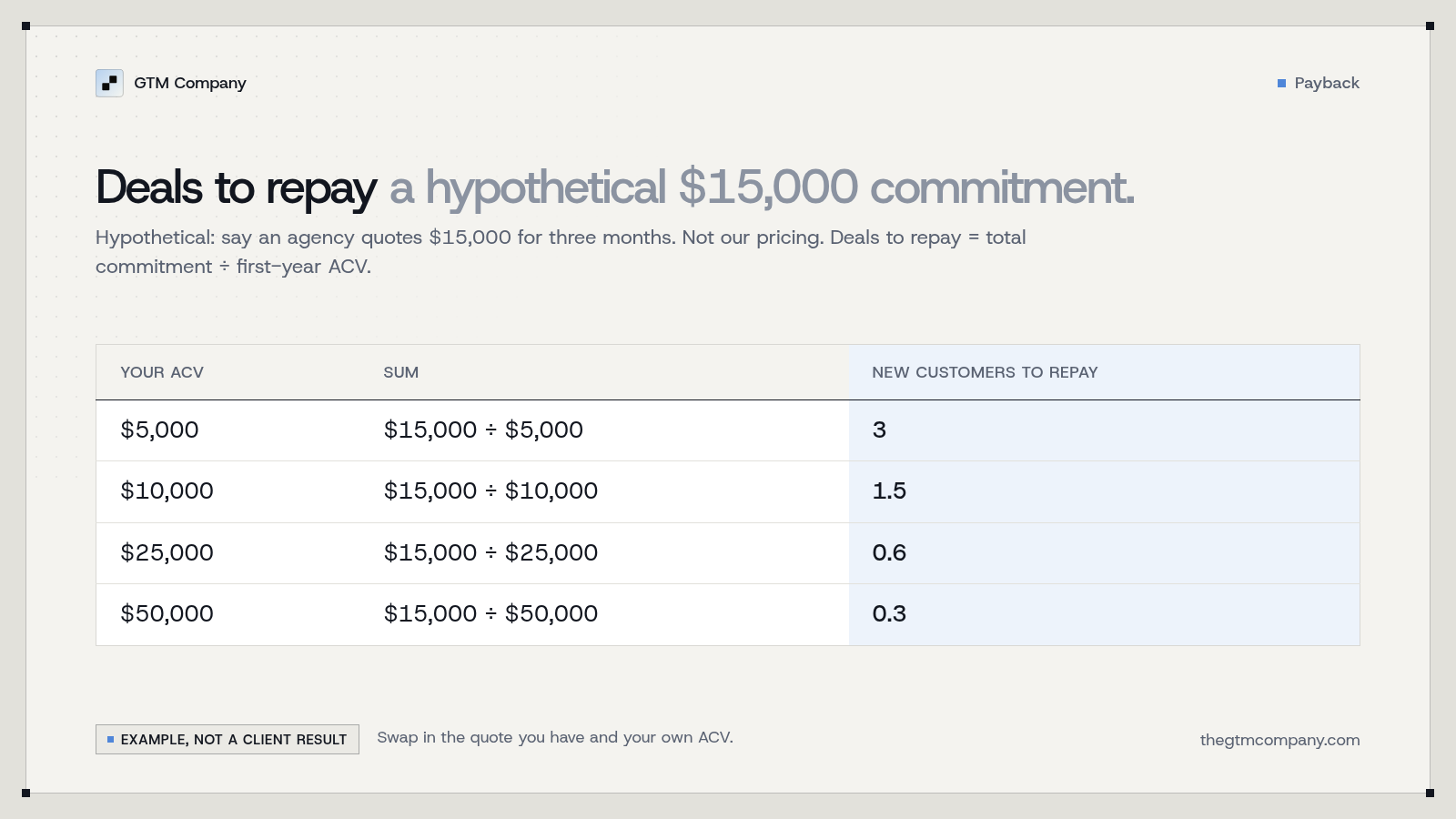
| Your ACV | New customers needed to repay $15,000 |
|---|---|
| $5,000 | 3 |
| $10,000 | 1.5 |
| $25,000 | 0.6 |
| $50,000 | 0.3 |
At a $25,000 ACV, one new customer pays for the whole engagement and then some. At $5,000, you need three customers from a channel that doesn't work for you yet. That's a real bet, and you should treat it as one.
Swap in whatever figure you've been quoted. If the commitment comes to $10,000 instead, one customer at a $10,000 ACV covers it on their own.
A worked example, step by step
Here is how I'd run it with a founder on a call. The numbers below are an example, not a client result. Replace every one with yours.
Step 1: write down the total commitment. Monthly fee multiplied by the minimum term, plus any set-up or tooling costs the agency charges on top. Say you've been quoted a total of $15,000 for three months with nothing extra. If there's a set-up fee, add it. Leaving it out is the most common way founders flatter the maths.
Step 2: write down your real first-year ACV. Take what your last ten or so new customers paid in their first year and average it. Don't use list price if you discount, and don't use your biggest logo. Say it comes to $12,000.
Step 3: divide. $15,000 ÷ $12,000 = 1.25. So the engagement needs to produce one and a quarter new customers to pay back on first-year revenue.
Step 4: work back to meetings. If you close one in five good-fit sales calls from people who didn't know you before, you need about six or seven of those calls to win 1.25 customers. Use your own close rate here, and be honest about it.
Step 5: ask whether that's plausible. Six or seven qualified meetings over three months, from a channel built properly, is a question you can put to any agency. Ask them how they would get there and what they'd do if the first attempt misses.
Step 6: write down what happens if it does pay back. If one combination of audience and message starts working, you don't only get those customers. You get something you can keep running. That part is harder to put a number on, so keep it out of the payback sum and treat it as upside.
The point of writing this down is that you stop arguing with a price and start arguing with a number you understand.
Why I count first-year revenue only
You could run this on lifetime value instead. If your customers stay for four years, one deal is worth four times as much and every agency looks cheap.
I'd rather you didn't. First-year revenue is the number you can bank on, and it's the one your co-founder or board will ask about. If the maths only works on lifetime value, it's a thinner case than it looks. If it works on year one, retention is upside.
There's a second reason. Lifetime value assumes the customers you win through outbound behave like the ones you won through referrals. They might, but you don't know yet. Someone who came in through a warm introduction has a relationship with you before they sign. Someone who answered a cold email doesn't. I'd wait until you have a few of them before assuming they stay as long.
Common mistakes when founders run this sum
I see the same handful of errors again and again. Each one makes the decision look easier or harder than it is.
Using monthly fee instead of total commitment. $5,000 against a $10,000 ACV looks like half a customer. The real figure, across three months, is one and a half. Always compare the full commitment.
Using referral close rates for outbound meetings. In my experience, people who meet you after a cold email tend to close lower than people introduced by a friend. If your referral close rate is high, don't assume outbound will match it. Use a lower figure and see if the maths still works.
Counting meetings, not customers. An agency that promises a number of meetings is promising a step in the middle of the funnel. You can't pay salaries with meetings. Run the sum on customers, then work back.
Ignoring your own time. If the alternative is you writing and sending cold email yourself, those hours belong in the comparison. Founder time is the most expensive time in the company.
Treating month one as the test. Domains need warming before they can send. A well-run engagement spends the first couple of weeks on research and set-up before anything goes out. If you judge payback on month one alone, every agency fails.
Where the maths stops working
The table also shows you when to walk away.
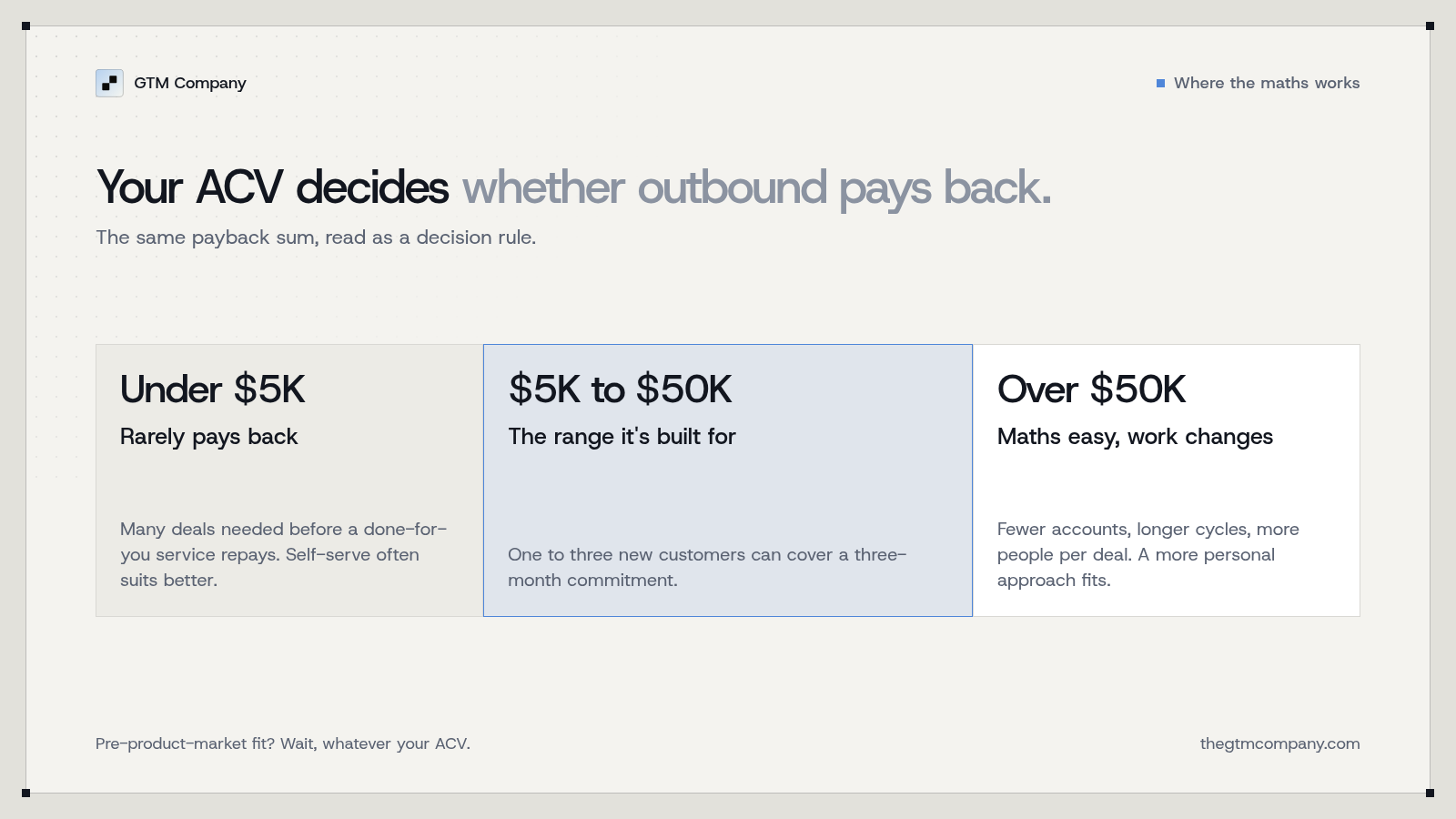
ACV under $5,000. At a $1,000 ACV, the same $15,000 needs 15 new customers before it pays back. That's a lot of deals to ask of a channel you haven't proven yet. We don't take on companies below a $5,000 ACV for this reason. Low-price products often sell better self-serve, where a buyer signs up without a call.
ACV over $50,000. Here the payback maths is easy, but the work changes. You're selling to fewer accounts, with longer cycles and more people involved in each deal. That calls for a different, more personal approach than testing messages across tens of thousands of emails.
Pre-product-market fit. If people aren't paying for the product yet, no amount of outbound will fix it. We'll tell you to wait.
A market that's too small. If there are only a few thousand companies that could ever buy from you, sending at volume can burn through them before you've learned anything. I've written about the rule we use in is your market too small for cold email.
What the fee should buy
Sending email is cheap. If an agency's fee mostly covers sending, you're overpaying, whatever the price.
The expensive part, and the part worth paying for, is finding out which message your market answers. At The GTM Company, that means:
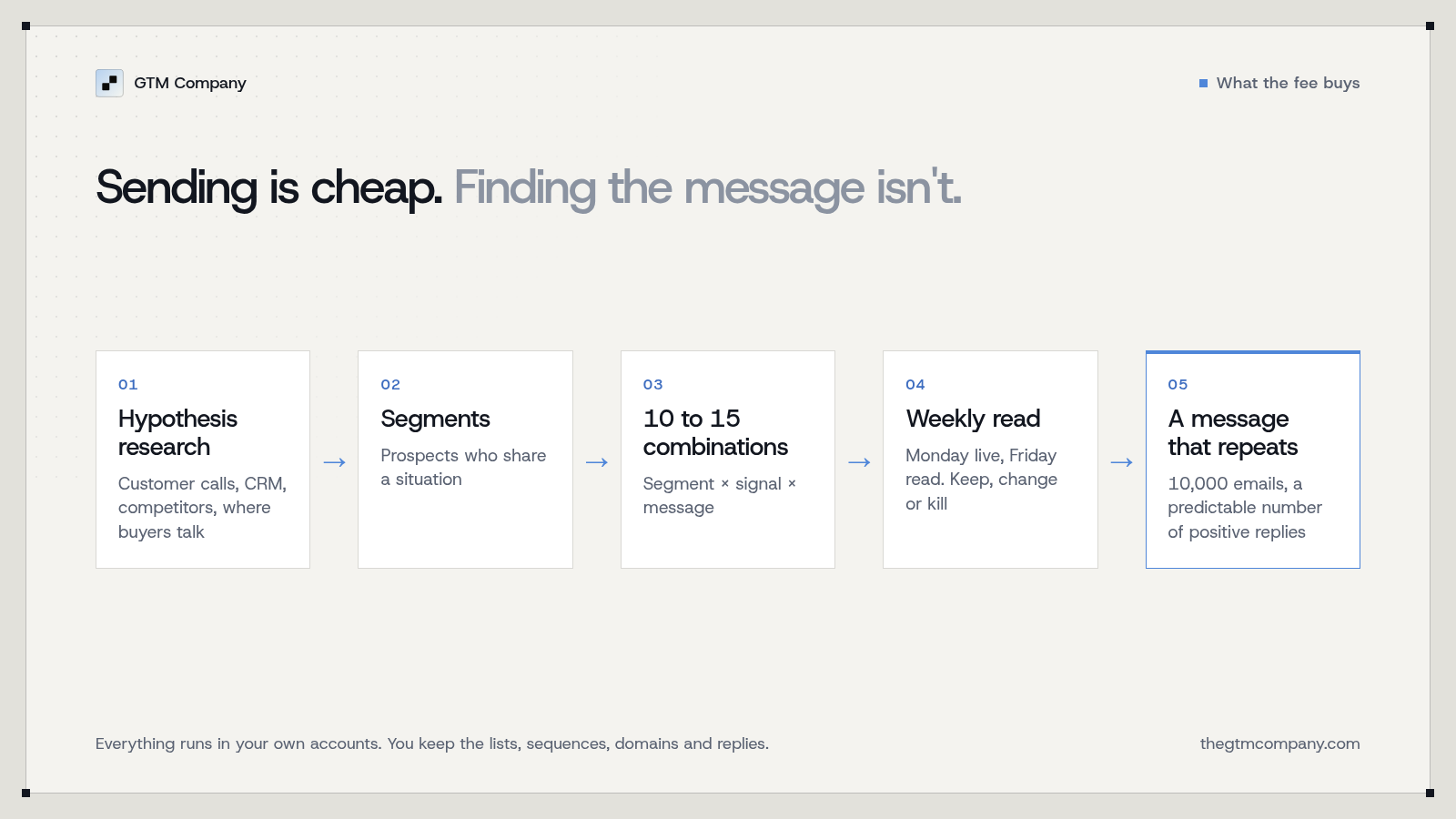
- research from your customer calls, CRM and the places your buyers talk about the problem
- splitting your market into segments that share a situation
- building 10 to 15 combinations of segment, signal and message and testing them in market
- reading every reply each week and deciding what to keep, change or kill
- the infrastructure underneath it: separate domains and inboxes, warm-up, lists, reply handling and booking
The finish line is specific. We're looking for a combination where we can send 10,000 emails to a segment and get a predictable number of positive replies back. Once you have that, you have something you can plan around.
A cheaper agency often sends one sequence to one list. If that sequence is right, you got a bargain. If it's wrong, you paid less to learn nothing. I've written more on how to tell agencies apart.
What you should own at the end
Price is only half of the value question. The other half is what you keep when the engagement ends.
With us, everything runs in your own accounts, and your main domain is never used for sending. You keep the lists, the sequences, the domains and every reply. Lead lists are yours once they're paid for.
That matters for the payback sum. If you walk away with nothing but a few meetings, you've paid for meetings. If you walk away with tested messages, segment lists and a record of what your market said back, you've paid for an asset you can hand to an SDR or run yourself. Ask any agency you're comparing what you own at the end, and get the answer in writing.
Four questions to answer before you sign
Get these down on paper first. They decide whether any outbound spend makes sense, ours or anyone else's.
- What does a new customer pay you in year one? Use your real average, not your best deal.
- What's your close rate on a good-fit sales call? In my experience, outbound meetings tend to close lower than referrals, so I wouldn't use your referral close rate.
- How many new customers do you need this year, and how many are you on track for? The gap between those two numbers is what you're trying to close.
- What happens if that gap stays open? A delayed hire, a harder raise, a target you miss.
Once you have the first two, you can take the model further, from emails sent to positive replies to meetings to customers. I've broken that down step by step in will outbound pay back.
If cash is the problem, not the maths
Sometimes the maths works and the bank balance doesn't. If three months of fees would put payroll at risk, don't sign. That's true of any agency.
If your market sits near the 5,000-company floor, lower sending volume is the better fit anyway, because it protects the market from being burned. A smaller programme also costs less each month.
If you need to take the decision to a co-founder or board, the payback sum is the page to bring. I've written about how to put that case together in how to get your co-founder or board to sign off on outbound.
The cost of doing nothing
Doing nothing still costs you something. While pipeline depends on referrals and the founder's network, every hiring plan and fundraising target rests on something you can't turn up when you need it. Founders who send cold email themselves pay in hours, and their hours are the most expensive ones in the company.
The comparison worth making is the cost of an agency against what one, two or three extra customers a quarter would change for you. For a SaaS company selling a $10,000 to $50,000 product, that answer is usually clear once it's written down.
FAQ
How much does a cold email agency cost? It varies a lot, and many agencies, us included, don't publish prices on their websites. Rather than comparing monthly fees, compare total commitment against your ACV and ask what testing each fee includes.
Is a cheaper agency a better place to start? Sometimes. If the cheaper option runs one sequence to one list, you're paying less for a single guess. If it's wrong, you've learned very little. Ask how many combinations they test in month one.
Should I include lifetime value in the payback sum? I wouldn't. Run it on first-year revenue. If it works there, retention is a bonus. If it only works on lifetime value, the case is weaker than it looks.
What if my ACV is under $5,000? The maths rarely works for a done-for-you outbound service at that price point. Self-serve and product-led routes tend to suit lower-priced products better.
When should I expect the first emails to go out? New sending domains need about 14 days of warm-up before they carry cold email, so nothing goes out before that. More on timing in planning to start outbound in January.
Run it on your numbers
Bring your ACV and close rate to a call and we'll run the payback maths with you. If it doesn't add up, we'll say so. Book a time at thegtmcompany.com.