You've had a good call with an agency, the plan makes sense, and now you need someone else to agree. A co-founder, a CEO, a board. That's a normal part of buying anything that costs real money, and nobody should push you to skip it.
The trouble is that the person who wasn't on the call hears a short version: "an agency wants $X a month for cold email". Put that way, the answer is usually no. This post gives you a one-page outbound business case to take into that conversation instead, so the decision is made on the same information you had.
Below you'll find the five questions you'll be asked, the one-page template, a filled-in example, how to write the risks honestly, the checkpoints to agree up front, and the mistakes that usually sink a proposal.
What the other person is worried about
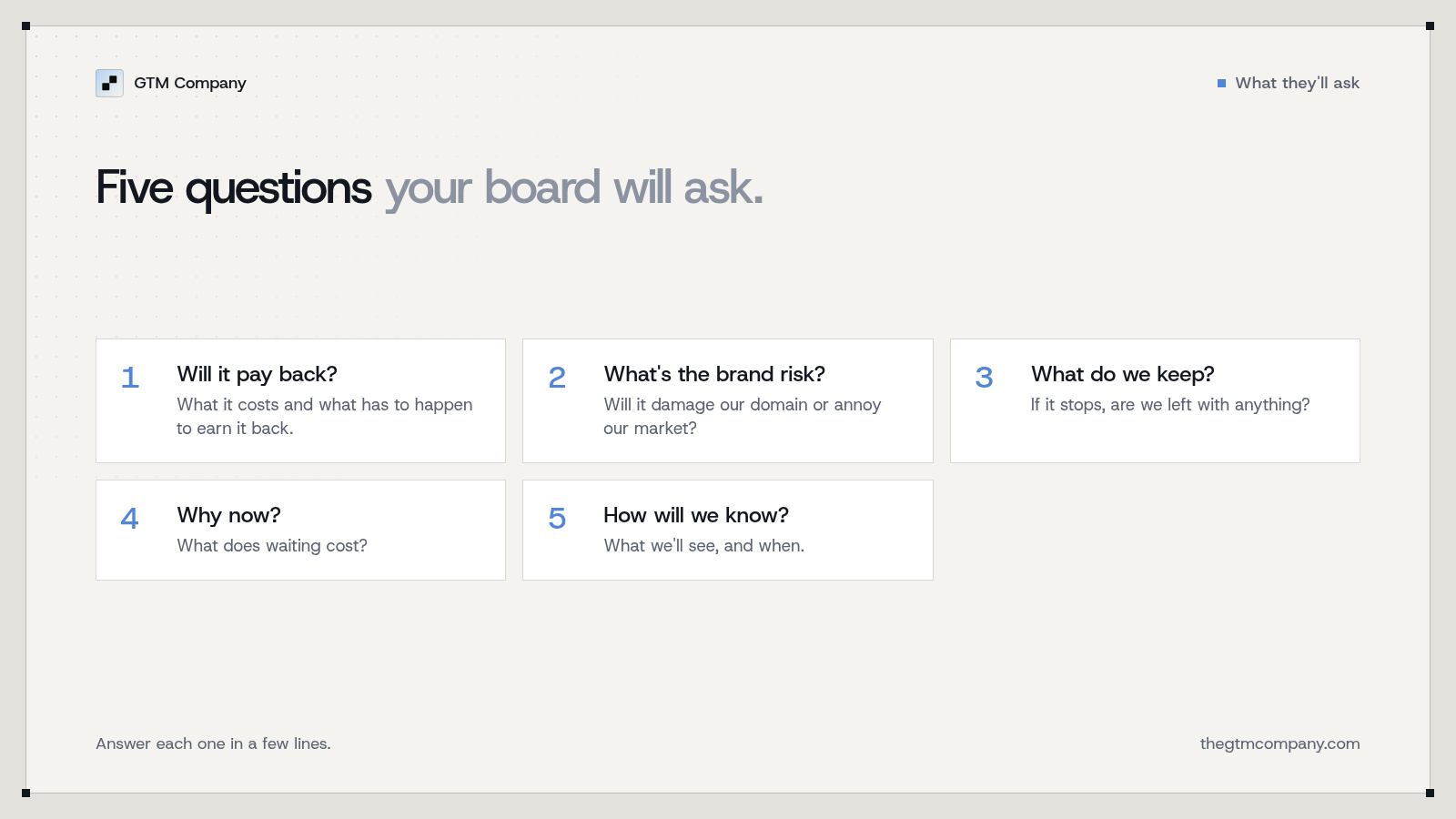
Before writing anything, it helps to know the questions you'll get. In my experience they come down to five:
- Will it pay back? What does it cost, and what has to happen for it to earn that back?
- What's the risk to the brand? Will cold email damage our domain or annoy our market?
- What do we keep? If it stops, are we left with anything?
- Why now? What does waiting cost?
- How will we know if it's working? What will we see, and when?
A good business case answers each one in a few lines.
The one-page template
Copy this structure and fill it with your own numbers.
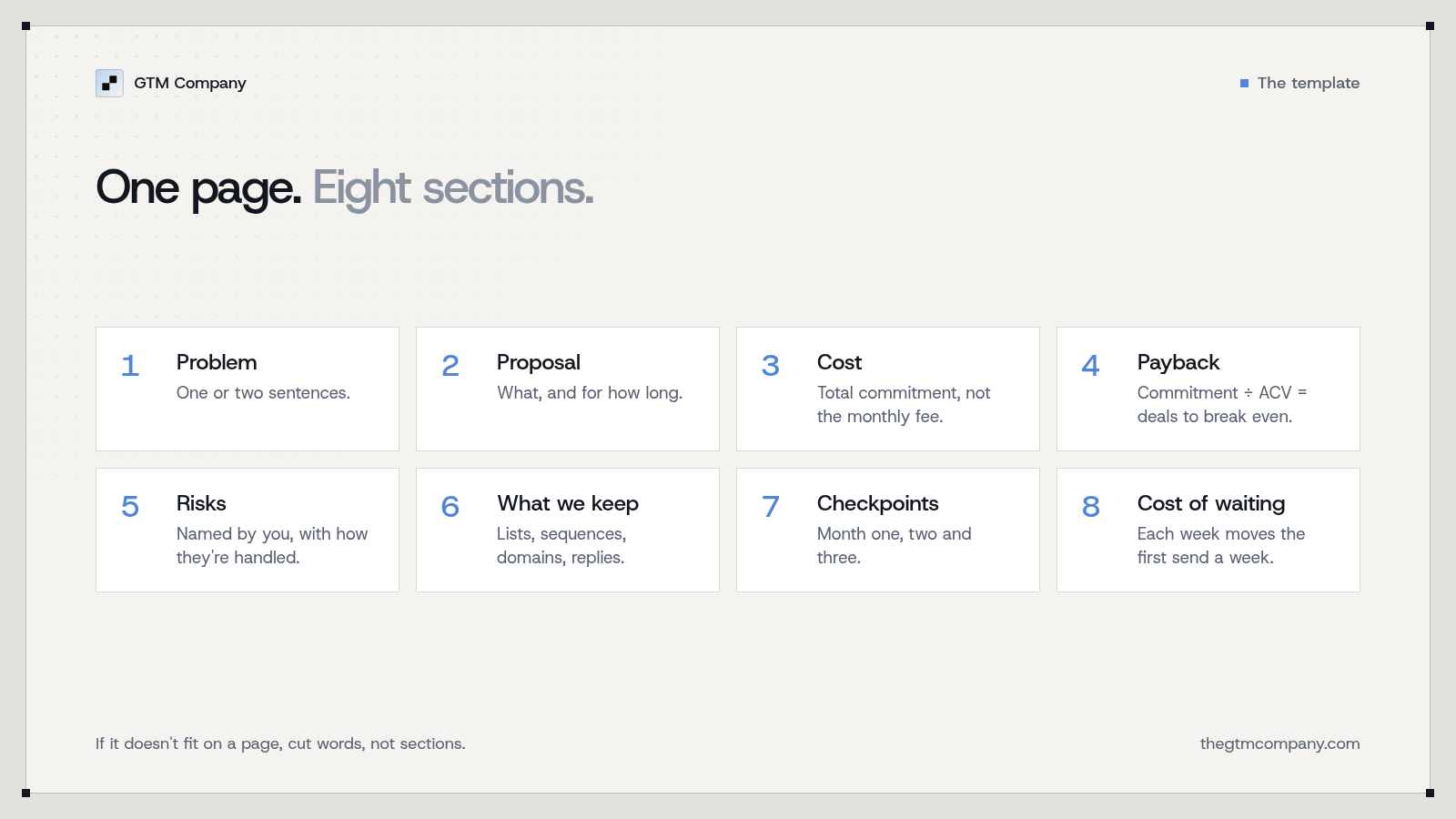
1. The problem. One or two sentences. For example: "Most new customers come from referrals and founder-led sales. Pipeline is uneven month to month and we can't plan hiring around it."
2. The proposal. What you're buying and for how long. For example: "A three-month engagement to find a message that books qualified meetings by cold email, tested across 10 to 15 combinations of segment, signal and message."
3. The cost. The total commitment, not the monthly fee. Include anything you'll pay separately, such as domains, sending tools or data.
4. Payback. Total commitment divided by your ACV gives the number of customers needed to break even. If that's one or two, say so. I've written up the full sum in is a $5K a month cold email agency worth it and a fuller model in will outbound pay back.
5. The risks and how they're handled. See the next section.
6. What we keep. Lists, sequences, domains, replies and the learning about which segment answers which message.
7. Checkpoints. What you'll review in month one, month two and month three, and what result would make it worth continuing.
8. The cost of waiting. How many months of pipeline you lose by starting later.
That fits on one page. If it doesn't, cut words, not sections.
A filled-in example
This is what the template looks like with numbers in it. Everything below is an example, not a client result. Swap in your own.
Problem. 80% of new customers in the last year came from referrals and founder-led sales. Two months had no new deals. We can't plan the next hire around that.
Proposal. Three months to find a cold email message that books qualified meetings with heads of operations at companies of 50 to 500 staff. 10 to 15 combinations tested, read weekly.
Cost. $15,000 total commitment over three months (a hypothetical quote), plus any tools we pay for directly.
Payback. Our ACV is $25,000, so 0.6 of a new customer covers the cost. One new customer pays it back with room to spare.
Risks. Sending from separate domains, never our main one. Volume matched to the size of our market. A do-not-contact list of customers and open deals before launch.
What we keep. Lists, sequences, domains, every reply and the weekly reports, whatever happens.
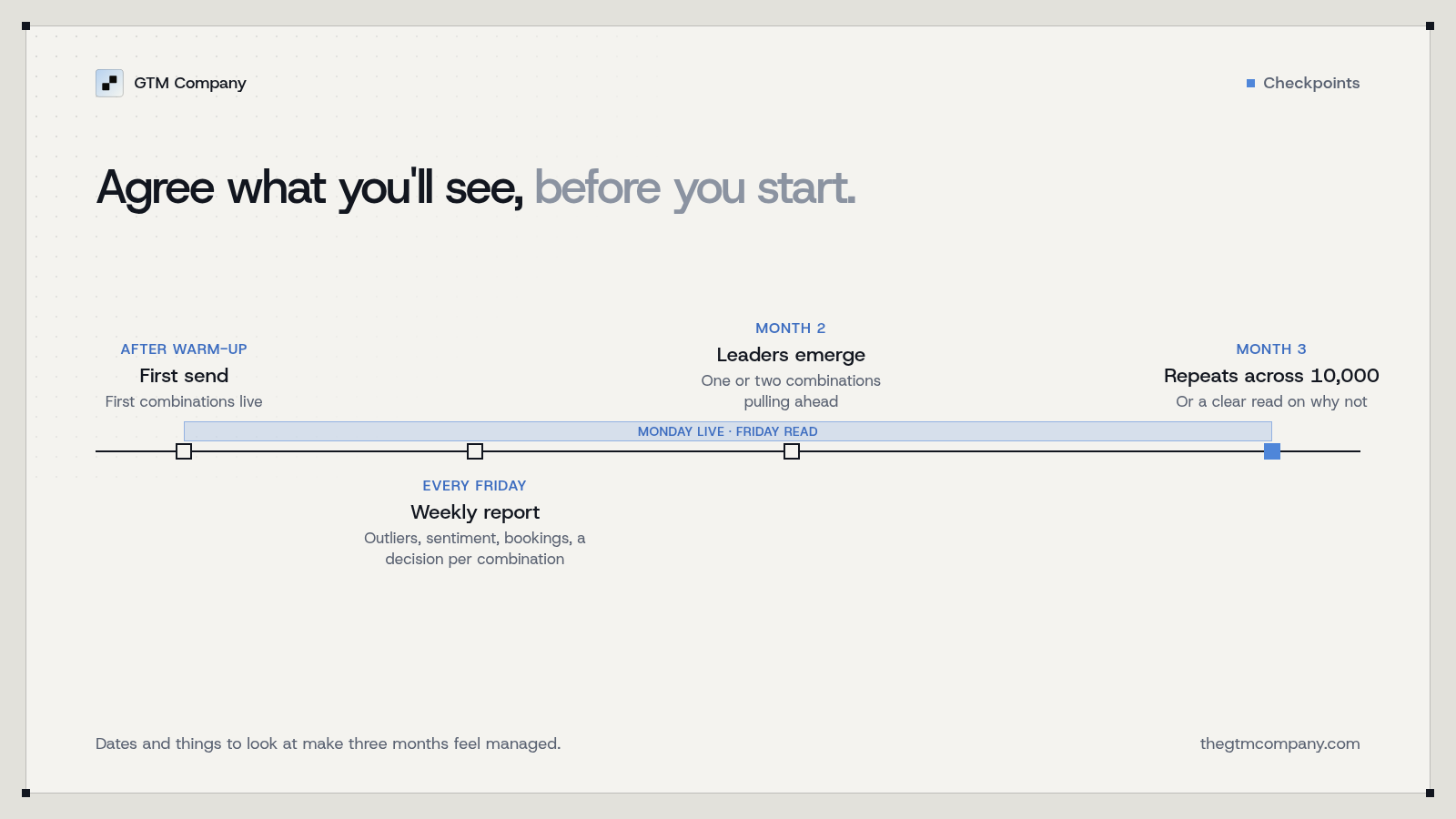
Checkpoints. Month one: combinations live and reports arriving. Month two: one or two combinations pulling ahead. Month three: a combination that repeats across 10,000 emails, or a clear read on why not.
Cost of waiting. Every week we wait moves the first send by a week.
Notice what the example doesn't do. It doesn't promise a number of meetings or a revenue figure. It shows how many deals pay the cost back and what you'll be able to see along the way. A board can judge that.
How to write the risks section honestly
Boards trust a proposal more when it names the risks itself. Here are the main ones with cold email and how a decent setup handles them.
Brand and domain risk. Your main domain should never be used for cold email. A proper setup sends from separate domains bought for the purpose, warmed up for about two weeks before the first send, with sending kept within safe daily limits. If your main domain is at risk, the setup is wrong.
Annoying your market. Volume should match the size of the market. A market with 5,000 to 30,000 target companies needs lower volume, so it isn't burned. Below 5,000 there usually aren't enough companies for cold email to be worth testing at all. There's more on that in is your market too small for cold email.
Emailing your own customers. Send a do-not-contact list of current customers and open deals before launch.
Paying for nothing. This is the real risk, and it's why the guarantee matters. Ours is that if we haven't found the winning message by the end of the three months, we keep going at no cost until we do. Whatever agency you're looking at, write its guarantee into the one-pager in its own words, from the contract.
What we keep, even if it stops
This is the section that tends to change the conversation, because most people assume a cancelled agency leaves nothing behind.
Ask for it in writing. With us, everything runs inside your own accounts, and lead lists are yours once paid for. If we stop, you keep the lists, the sequences, the domains and every reply. You also keep the weekly reports, which show what each segment and message did.
Even a test that doesn't find a winner tells you something useful: which segments don't respond, which problems don't land, and which offers your buyers ignore.
Bring them into the process
Two things make sign-off easier.
Invite them to the next call. It's quicker for the decision maker to ask their questions directly than to have you relay them. We'd rather have the person who signs on the call than send a deck afterwards.
Agree the checkpoints up front. A board is more comfortable approving three months when it knows what it will see in week two, week six and week twelve. Weekly reports, live on Monday and read on Friday, give them that.
How to run the conversation
The one-pager does most of the work, but the order you take it in matters. This is the sequence I'd use.
- Send it the day before. Nobody likes reading a proposal for the first time in the meeting. A day gives them time to form questions instead of objections.
- Open with the problem, in their words. If your co-founder has said "pipeline is lumpy", use that phrase. You're reminding them of a problem they already agree with.
- Walk through payback before cost. Show how many deals cover the commitment, then the commitment itself.
- Raise the risks yourself. Go through brand, market and customer risk before they're asked. It shows you've thought about the downside.
- Spend time on what you keep. This is usually where a sceptical listener changes their mind.
- Agree the checkpoints, even if they say no. If the answer is "not yet", the checkpoints become the conditions for revisiting it.
- Ask for a decision, or a date. "Can we decide by Friday?" is better than leaving it open.
Common mistakes that sink a proposal
Leading with the monthly fee. Lead with the problem and the payback. The fee only makes sense next to what it has to earn back.
Promising meetings you can't promise. If the agency doesn't guarantee a meeting count, don't put one in the memo. A board that is told "about 30 meetings a month" will hold you to it.
Hiding the risks. If you don't name brand and domain risk, someone else will, and it'll look as if you hadn't thought about it.
Skipping what you keep. "What if it doesn't work?" is the question that decides most of these conversations. Answer it before it's asked.
No checkpoints. "Let's see how it goes" makes three months feel open-ended. Dates and things to look at make it feel managed.
Relaying instead of inviting. Every relay loses detail. Get the decision maker on the call.
FAQ
How long should the business case be? One page. If it runs longer, the decision maker reads the first half and skims the rest.
Should I include a forecast? Include the payback sum and, if it helps, a range of outcomes clearly labelled as an example. Don't present an example as a forecast.
What if my board wants a guarantee? Quote the agency's guarantee in its own words from the contract, including the conditions. Don't paraphrase it into something stronger.
What if we've tried cold email before and it failed? Say so, and say what's different this time. Why your cold email didn't work may help you explain it.
What if my co-founder thinks we should hire an SDR instead? Put both options on the page with their real costs and timelines, and let the comparison do the work. I've laid out the trade-offs in SDR vs outbound agency.
Who should be on the call? Whoever signs, and whoever will approve copy and answer questions about customers during the engagement.
If the answer is still no
Sometimes the answer is no for good reasons. The market may be too small, the ACV too low, or the company may not have paying customers yet. In those cases, outbound may not be the right channel for you yet, and it's better to hear that before you spend money.
If the answer is "not this quarter", write down what would need to be true to say yes. Then you'll know when to come back to it. Starting outbound in January covers how far ahead to plan.
Want help with the one-pager?
If it'd help to have your co-founder or board hear it first-hand, book a call for both of you at thegtmcompany.com. We'll go through the numbers together and answer their questions directly.