"Not now, maybe January" is a reasonable answer to a lot of things. Budgets reset, teams come back, and a new quarter feels like the right time to start something.
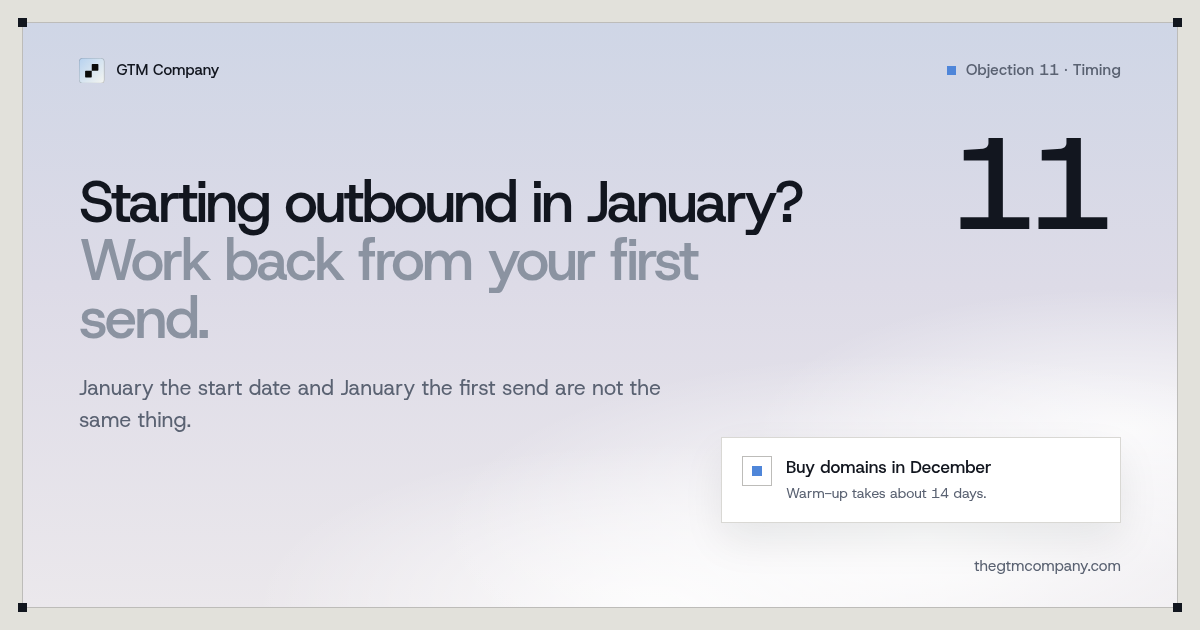
With outbound, the catch is that January the start date and January the first send are not the same thing. Cold email has a lead time, and most of it can't be shortened. If you want emails going out in January, a lot of the work needs to happen in December. This post works back from the first send so you can plan it, with a dated example, a December checklist, the mistakes that push a January start into February, and a short FAQ.
Why outbound has a lead time
Three pieces of work come before the first email.
Domains and warm-up. You should never send cold email from your main domain. New sending domains need buying, setting up and warming up before they can send at volume. That takes about 14 days, and it can't be rushed without risking deliverability.
Research and segments. Before writing anything, someone needs to read your customer calls, CRM and competitors, then build the segments and signals the campaigns will target.
Copy and sign-off. Each combination of segment, signal and message needs writing, then approving by you. Every day the approval waits, the launch moves by a day.
These run partly in parallel, alongside the warm-up, so the 14 days of warm-up sets the earliest first send. None of them can be skipped.
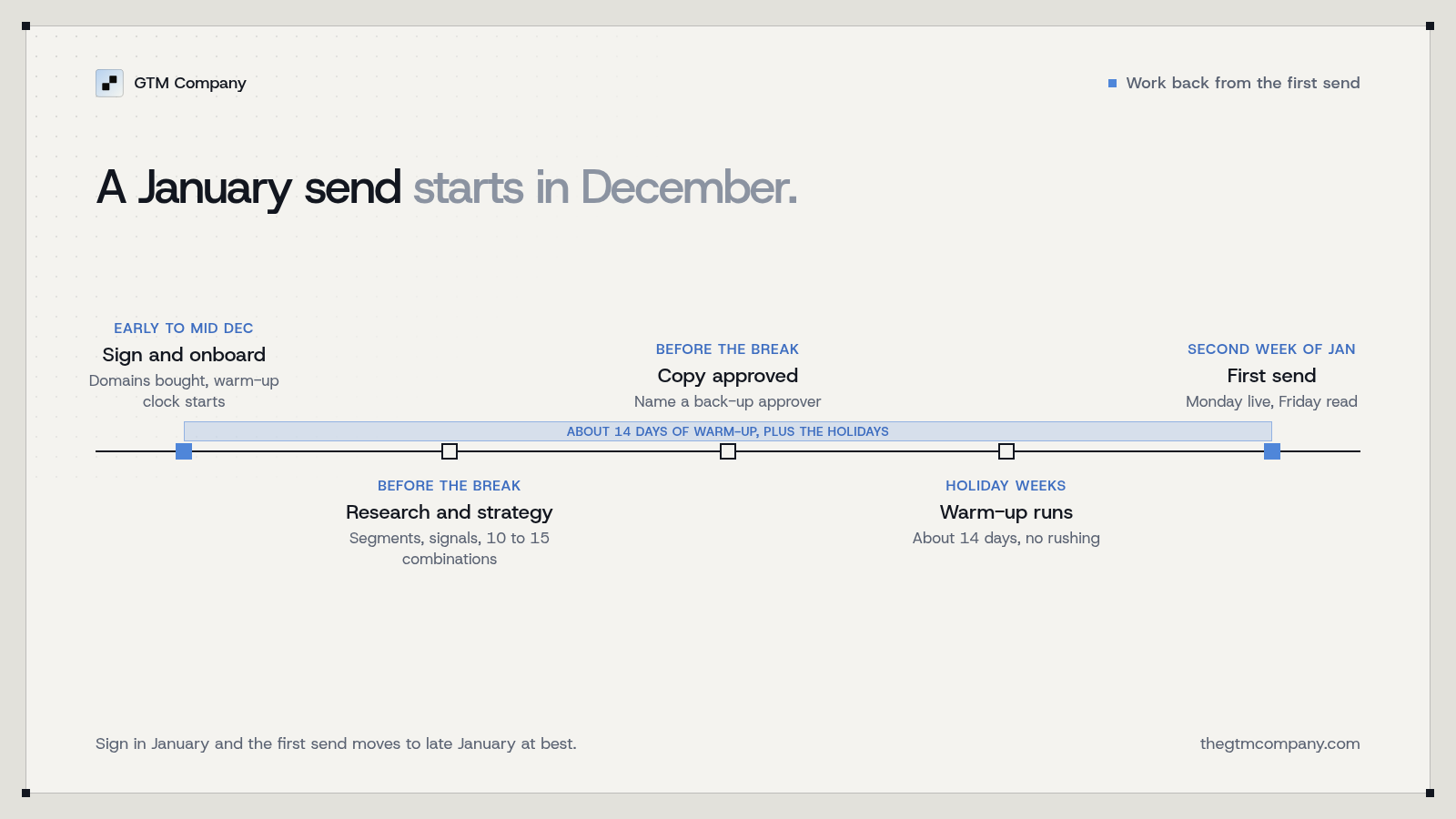
A timeline that works back from the first send
This is the order things happen in once you've signed:
- Domains first. Sending domains are bought straight away, so the warm-up clock starts.
- Inputs. Customer calls, a CRM export and your best customer list are collected for the research.
- Strategy call. Segments, signals, offers and the 10 to 15 combinations agreed, along with the target that counts as a winning message.
- Copy. Written and sent for your approval.
- First send, once warm-up has finished.
A worked example with dates
These dates are an example. Swap in your own.
Say you want your first emails out on Monday 11 January 2027.
- Warm-up needs about 14 days, so the sending domains need to be live and warming by around Monday 28 December.
- That falls in the holiday week, when nobody is around to sign anything or answer onboarding questions. So in practice, the domains should be bought before the break.
- Research and the strategy call need the people who know your customers. Book them for the first half of December.
- Copy approval needs whoever signs off on messaging. If they're away from 18 December, the copy needs to be with them before then, or the first week of January becomes approval week instead of send week.
Put together, signing in the first week or two of December gives a first send around 11 January. Signing on 2 January gives a first send in the second half of January at best.
So if you want a first send in the second week of January, the domains need buying around the end of December. Given that the last two weeks of December are slow for most teams, the realistic answer is to sign and start onboarding in early to mid December.
What to do in December
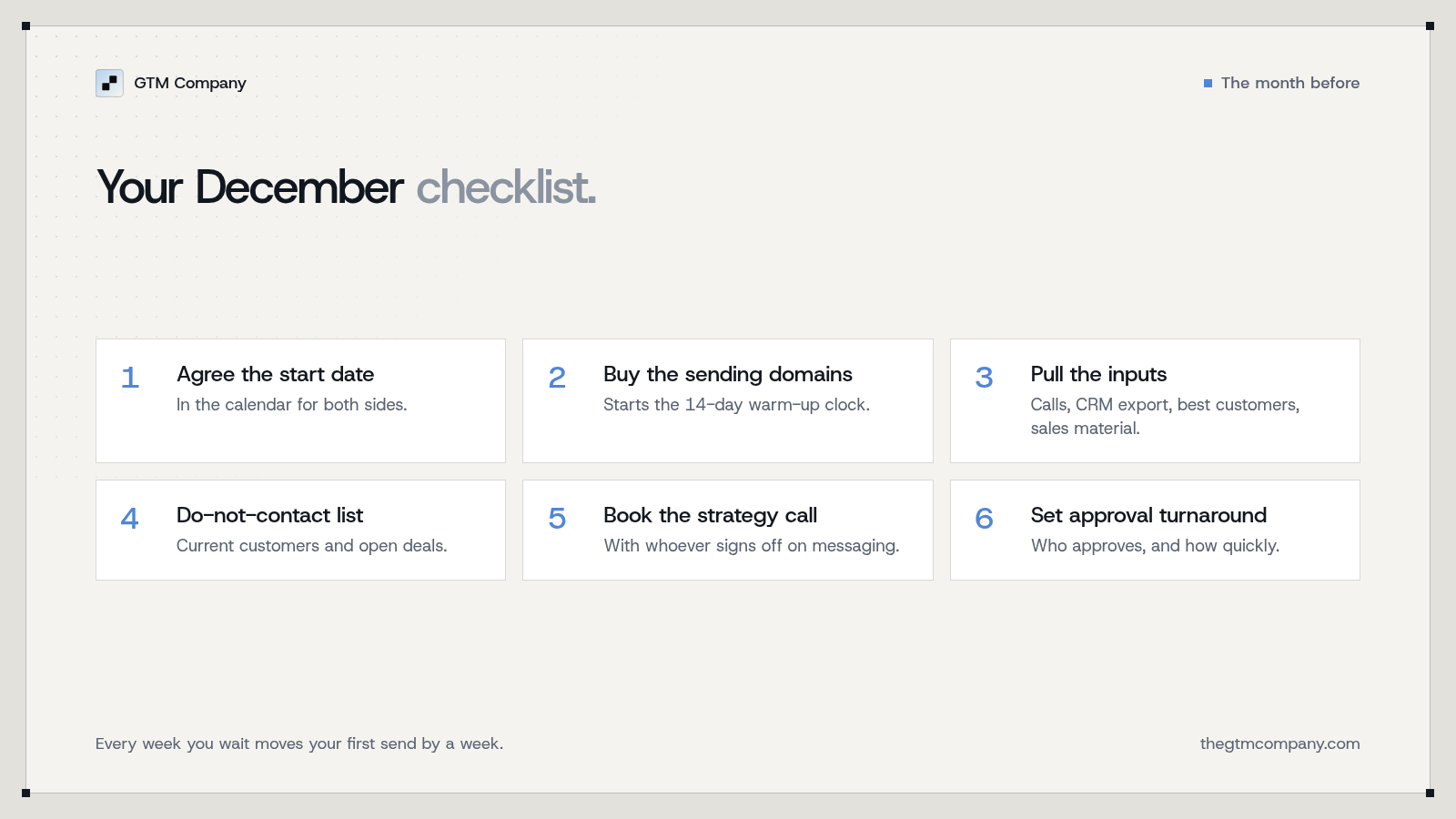
If January is your plan, use this checklist for the month before.
- Agree the start date. Put it in the calendar for both sides.
- Buy the sending domains. This starts the 14-day warm-up clock.
- Pull the inputs together. Recorded customer calls, a CRM export, your best customer list and any sales material.
- Build the do-not-contact list. Current customers and open deals, so nobody you already know gets a cold email.
- Book the strategy call with whoever signs off on messaging, before people leave for the holidays.
- Set a turnaround for copy approval. Decide who approves and how quickly.
Done this way, the first send can land in the first half of January instead of the end of it.
What the first quarter looks like after a January send
Once the first emails are out, the rest of the quarter follows a weekly rhythm. Combinations go live on a Monday and get read on a Friday, and each one gets a decision: keep, change or kill.
January. First combinations live. Early replies show which segments are paying attention and which messages are being ignored. The first Friday reports arrive.
February. Losers are cut and new versions are written from what the replies say. One or two combinations usually start to pull ahead.
March. The leading combinations run across enough emails to show the result repeats. The aim is a combination that holds up across 10,000 emails to a segment.
Meetings book throughout, from the first positive replies onwards. Closed revenue depends on your sales cycle, which is why the start date matters more than it looks.
What to have ready on day one
The faster these arrive, the faster the research starts. Gather them in December even if you haven't signed anything yet.
- Recorded customer calls. Sales calls, onboarding calls and churn calls are all useful. They're where your buyers' own words come from.
- A CRM export. Closed-won and closed-lost deals, with company names, sizes and notes.
- Your best customer list. The customers who bought fastest and stayed longest.
- Sales material. Decks, one-pagers and case studies you're cleared to use.
- Competitors. The names your buyers compare you with.
- The do-not-contact list. Customers, open deals and anyone you've promised not to email.
None of this commits you to anything, and it makes the January start a lot smoother.
The same lead time applies in-house
If you're planning to run outbound yourself in January, none of this goes away. You'll still need to buy domains, set up the authentication records, create mailboxes and warm them up for about two weeks before sending at volume. You'll also need a list, a sending tool and a plan for handling replies. Starting the technical set-up in December gives you a clean first send in January, and leaves the first weeks of the new year for writing and testing. Running cold email in-house covers the full set-up.
What waiting costs
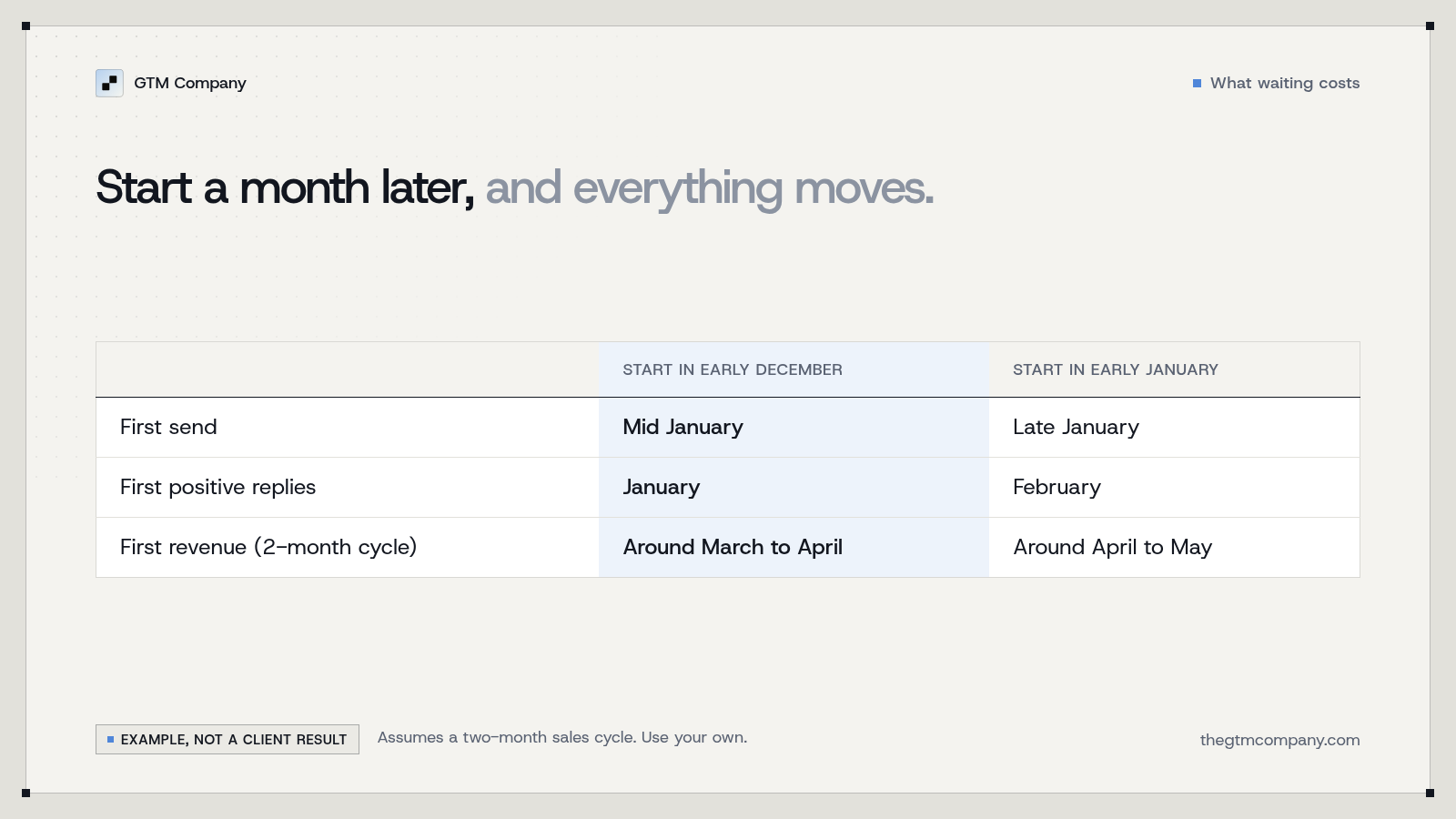
Every week you wait moves your first send by a week. That sounds obvious, but it's easy to miss the knock-on effect.
Outbound results arrive in stages. First sends, then replies, then meetings, then closed deals after your sales cycle. If your sales cycle runs two months, a first send in late January means the first revenue from it lands around April. Starting a month later pushes that back a month too. I've covered how this lag affects payback in will outbound pay back.
Common mistakes that turn January into February
Signing in January. If the contract is signed on the first working day of the year, the first send can't happen until warm-up is done, around two weeks later at best.
Leaving the inputs until after the holidays. Customer calls, CRM exports and the best customer list take longer to pull together than people expect. Do it in December.
Nobody owning copy approval. If the person who signs off is away, launch waits. Name a back-up.
Forgetting the do-not-contact list. It's a quick job, but launch shouldn't happen without it.
Treating January as a fresh start for the message. If the messaging is going to change in Q1 because of a pricing or product change, decide that before the strategy call, not after.
FAQ
Can warm-up be shortened? Not safely. Rushing it risks your sending domains landing in spam, which costs more time than it saves.
Can we start research in December and sign in January? Talk to us about the dates. The domains are what start the clock, and they come after signing.
Is December a bad month to send? Many teams are slow in the last two weeks. That's one reason to use December for set-up and send in January.
What if our budget resets in January? Then agree the start date now and line up the inputs, so day one in January is onboarding rather than planning.
We're pre-revenue. Should we start in January anyway? If you don't have paying customers yet, outbound is unlikely to fix that. We'd tell you to wait.
When waiting is the right call
Sometimes January is the right answer, and it's worth being honest about when.
- Your budget resets in January and there's no money before then.
- You're about to change something big, such as pricing, positioning or the product itself, and messaging tested now would be out of date.
- You don't have paying customers yet. If you're pre-product-market fit, outbound is unlikely to fix that, and we'd tell you to wait.
If one of those applies, waiting is sensible. Use the time to pull your inputs together, so the start is quicker when it comes.
If you're not ready to sign in December
That's fine. You can still make January quicker without committing to anything. Pull the inputs listed above, write down your best guess at two or three segments, and decide who will approve copy. When you're ready to start, the research can begin on day one instead of week two. If you're comparing options, use the time to put the same questions to each agency; how to choose a cold email agency has a list.
When "January" is a soft no
Sometimes "maybe January" means "I'm not convinced yet". That's worth saying out loud, because it changes what to do next. If you're unsure whether outbound will pay back, whether your market is big enough, or whether an agency can understand it, those are better answered now than in January.
These posts cover the most common reasons:
- Is your market too small for cold email?
- Is a three-month outbound contract too long?
- How to tell if an agency understands your market
Plan your start date with us
If you'd like a January first send, book a call at thegtmcompany.com and we'll work out the dates with you. If waiting makes more sense for your situation, we'll say that too.