You can run cold email yourself. The tools are cheap, the tutorials are free, and nobody knows your product better than you do. Plenty of founders try it, and some do it well.
The two things that catch founders out are set-up time and speed. This post covers what you'll need to build, the volume maths that decides how fast you learn, and how to work out whether doing it in-house is the best use of your time. It ends with a seven-step way to run it yourself, the mistakes that cost founders the most time, and a short FAQ.
What you need before the first send
A lot of in-house attempts stall before a single email goes out. This is the set-up to plan for.
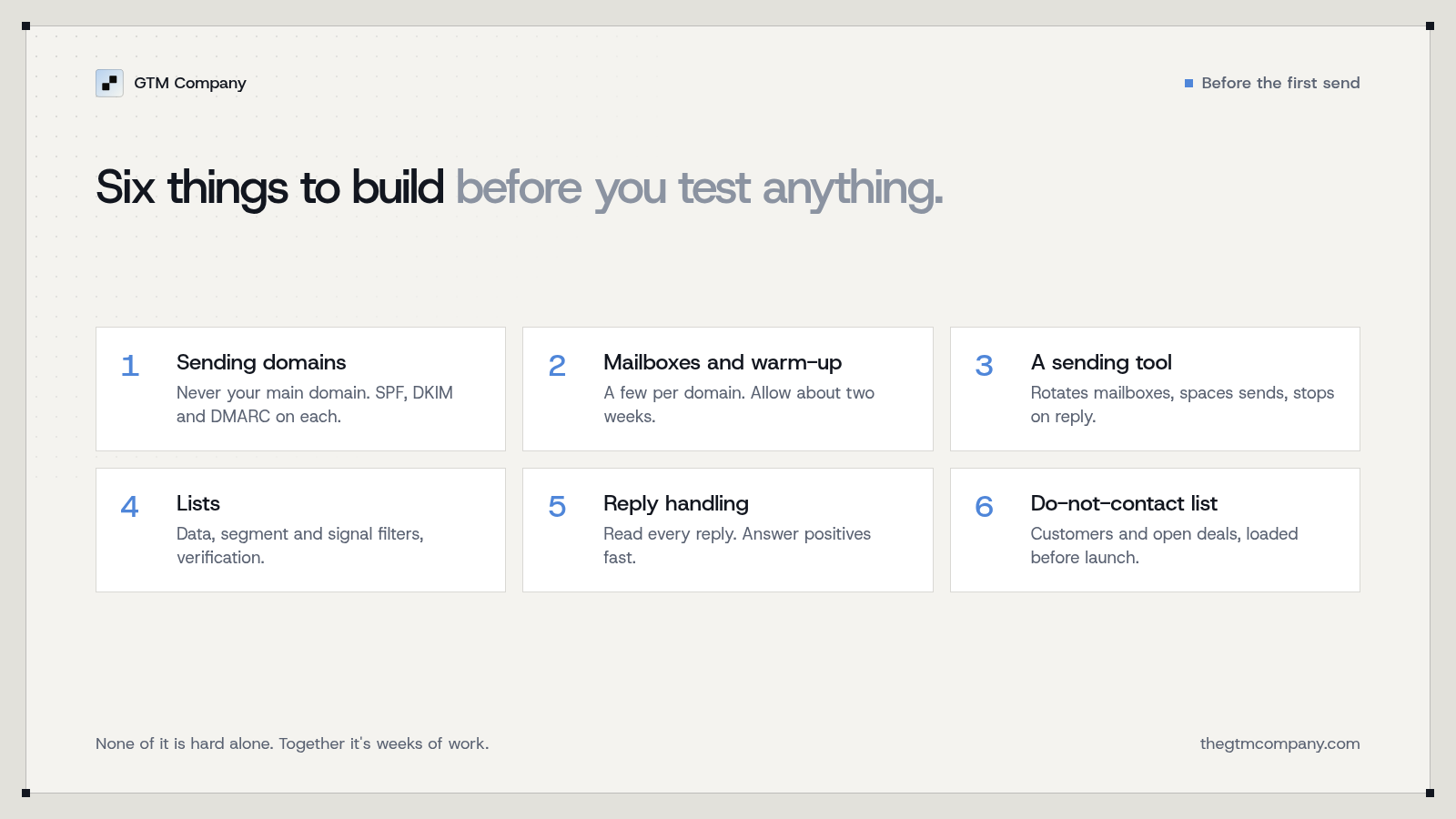
Sending domains. Never send cold email from your main domain. Buy separate domains that look like yours, and set up the authentication records (SPF, DKIM and DMARC) on each.
Mailboxes and warm-up. Create a few mailboxes on each domain and warm them up before sending. Allow about two weeks.
A sending tool. Something that rotates mailboxes, spaces sends, handles sequences and stops when someone replies.
Lists. A data provider, a way to filter by segment and signal, and email verification so you're not sending to dead addresses.
Reply handling. Someone needs to read every reply, answer the positive ones fast and book the meetings.
A do-not-contact list. Your current customers and open deals, so they don't get a cold email from you.
None of this is hard on its own. Together it's a few weeks of work before you've tested anything, and it needs looking after once it's running.
Deliverability in plain English
If an email doesn't reach the inbox, nothing else you test matters. Three records do most of the work, and each one is set up once per sending domain.
- SPF lists the servers allowed to send email for your domain. Without it, receiving servers have no way to tell your sending tool from a spammer using your name.
- DKIM adds a signature to each email, so the receiving server can check it wasn't changed on the way.
- DMARC tells receiving servers what to do with email that fails those checks, and sends you reports about it.
On top of that, warm-up builds a sending history for each new mailbox before it carries cold email, and modest daily volumes keep that history healthy. Check your records with a free lookup tool before the first send, and again if reply rates suddenly drop.
The volume maths
This is the part that matters most. Say you send 100 emails a day, which is a sensible pace for one person with a small set of mailboxes.
- 100 emails a day across about 22 working days is around 2,200 emails a month.
- To know whether a combination of segment, signal and message works, we like to see it hold up across about 10,000 emails.
- At 2,200 a month, one combination takes four to five months to read properly.
In other words, at that pace you're testing roughly one idea at a time, and each idea takes months. If the first one misses, you're half a year in before the second has a fair result.
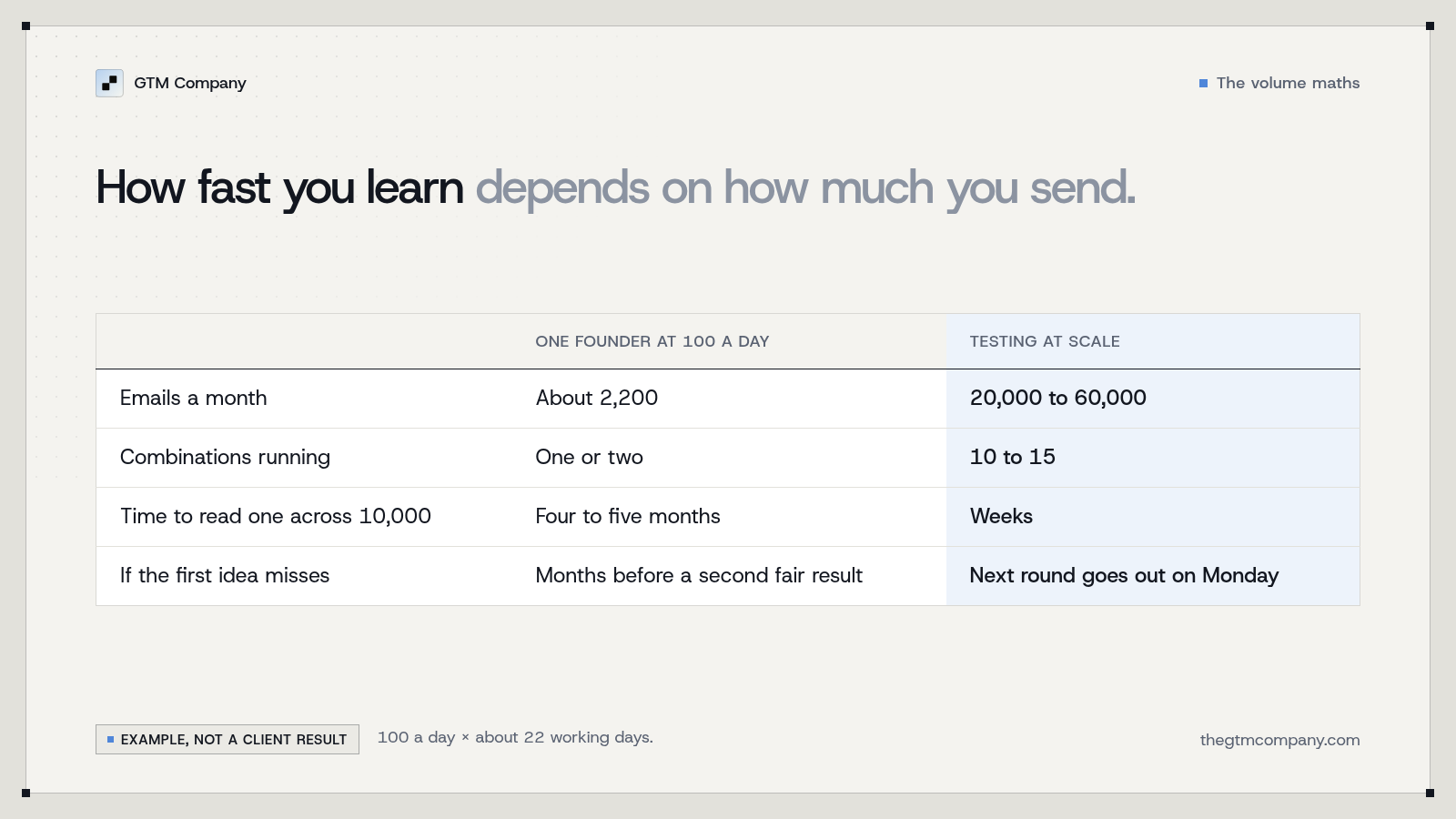
| One founder at 100 a day | Testing at scale | |
|---|---|---|
| Emails a month | About 2,200 | 20,000 to 60,000 |
| Combinations running | One or two | 10 to 15 |
| Time to read one across 10,000 emails | Four to five months | Weeks |
| If the first idea misses | Months before a second fair result | The next round goes out the next Monday |
Compare that with testing 10 to 15 combinations at once across 20,000 to 60,000 emails a month. That's the volume we run, and it's what lets a search for the right message finish in months rather than years.
You can send less than 10,000 emails and still learn something. A clear winner or a clear loser often shows up earlier. But the smaller the sample, the more likely you are to drop an idea that would have worked, or keep one that only had a good week.
What your time is worth
The other cost of doing it in-house is your time, which is usually the most expensive time in the company.
One video collaboration SaaS client was at around $1M ARR when they came to us. The CEO was spending four hours a day on outbound. Once we took it on, they got 400 qualified leads in seven weeks, with more than 100 by week three.
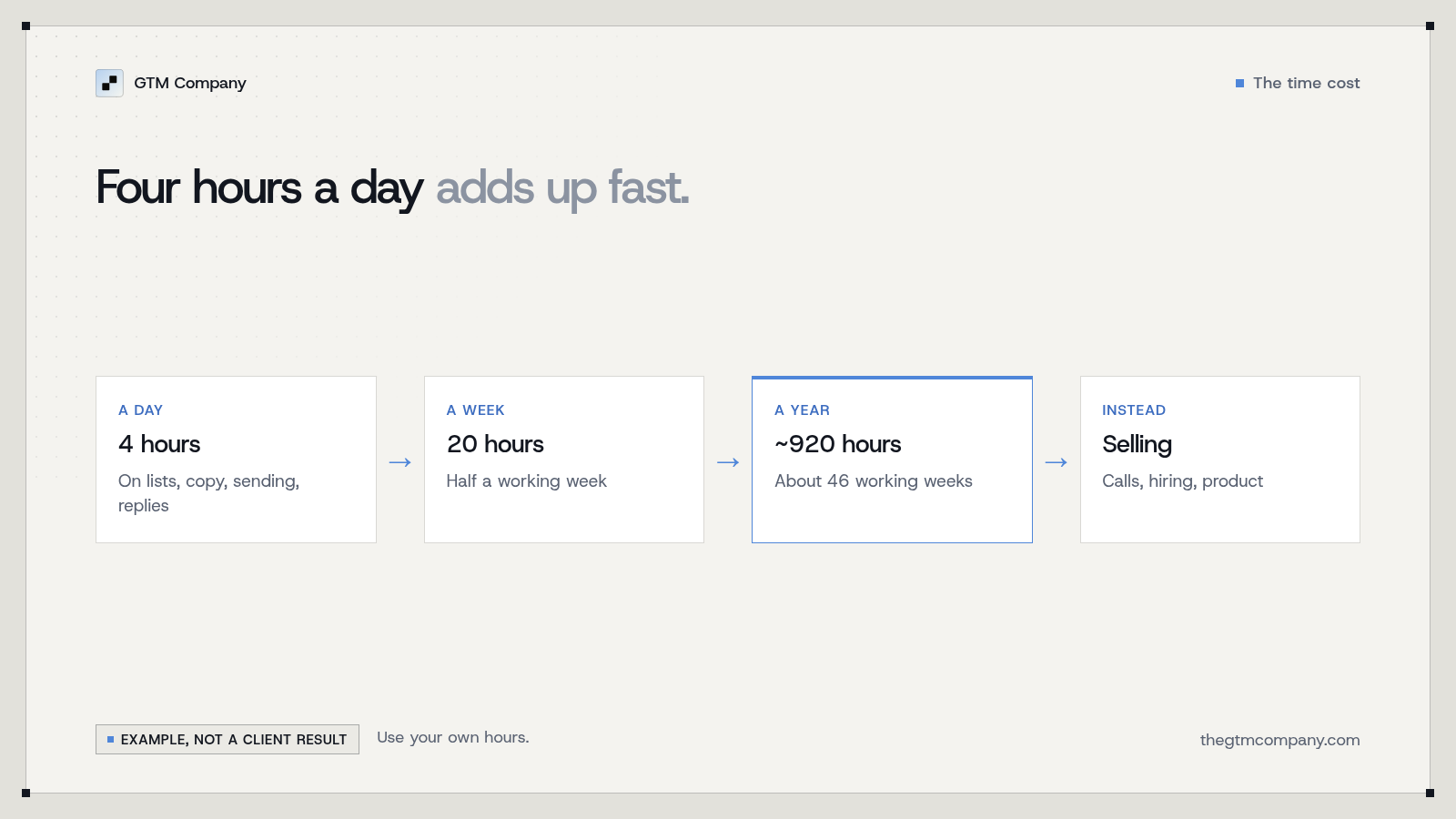
Four hours a day is half your working week. Before deciding, add up what that time is worth across a year, and what else it could go on: closing deals, hiring, product.
A worked example of the time cost
This is an example. Use your own hours.
- 4 hours a day, 5 days a week, is 20 hours a week.
- Across about 46 working weeks, that's around 920 hours a year.
- That's roughly half of a full-time year, spent by the person in the company most likely to close a deal.
Then ask what those hours would produce if they went on sales calls with the meetings outbound books, rather than on building lists and warming domains.
A first month, if you do it yourself
This is a realistic first month for a founder running it alone.
Week 1. Buy the sending domains, set up SPF, DKIM and DMARC, create mailboxes and start warm-up. Read ten recent customer calls and write down the problems in their words.
Week 2. Build two or three segments from your closed deals. Pull and verify the first lists. Write one message per segment with a small first ask. Load your do-not-contact list.
Week 3. Warm-up finishing. Final checks on records, links and unsubscribe handling. First sends go out at the end of the week or the start of the next.
Week 4. Read the first replies. Answer positive ones the same day. Note what each negative reply points at.
By the end of the month you'll have one or two combinations running and a few hundred emails sent per combination. That's enough to spot a disaster, and not yet enough to call a winner. Plan for the next three to four months on the same rhythm.
The middle option
You don't have to choose all or nothing. Some founders keep the research and the reply handling, because they know the buyer best, and hand over the infrastructure and the volume. Others have the search run for them and bring the winning message in-house once it's proven. Whatever split you choose, make sure the domains, lists and sequences sit in accounts you own.
If you're going to do it in-house, do it like this
If you decide to run it yourself, a few habits make a big difference.
- Research first. Read your best customer calls and your CRM notes. Write down the problems customers describe, in their words.
- Split by situation. Build two or three segments of companies that share a problem, not only a size and an industry.
- Find a reason to email now. For each segment, pick a signal that shows a company is in that situation today.
- Write one message per segment. About their problem, in their language. Keep the ask small.
- Test more than one thing at a time. Even two or three combinations running side by side will teach you faster than one.
- Read replies weekly. Set a day to look at what came back and decide what to keep, change or cut.
- Write the results down. Note what you sent, to whom and what happened, so the learning isn't lost.
If it's not working after a fair test, why your cold email didn't work has a diagnostic you can run.
Common mistakes founders make doing it in-house
Sending from the main domain. It's the fastest way to put your normal email at risk. Use separate domains, always.
Skipping warm-up to save time. New mailboxes sending at volume on day one tend to land in spam, and then the test tells you nothing.
Writing about the product. Founders know the product best, which makes it tempting to lead with it. Lead with the buyer's problem.
Letting replies sit. A positive reply answered two days later is worth much less than one answered in an hour. If nobody owns the inbox, the test leaks.
Not writing anything down. Three months in, nobody remembers which subject line went to which segment. Keep a simple log.
Calling it after one campaign. One list, one message and one offer is a sample size of one. More on that in why your cold email didn't work.
FAQ
How many emails a day can I send safely? It depends on how many mailboxes and domains you have and how well they're warmed. Spread sends across mailboxes and keep each one at a modest daily volume.
What tools do I need? Domains, mailboxes, a sending tool that rotates mailboxes, a data provider, email verification and somewhere to log replies. Your CRM can do the last one.
Can I hand it over later? Yes, if it runs in accounts you own. The same is true the other way: if an agency runs it in your accounts, you can bring it in-house later and keep everything.
Is in-house cheaper? In cash, usually. In time, usually not. Work out both before deciding.
When in-house is the right call
Doing it yourself is a good choice when:
- your market is small enough that high volume would burn it, and you'd rather go slowly and carefully
- you have a team member with outbound experience and time to run it
- you're happy for the search to take longer in return for lower cash spend
When it isn't:
- the founder is the only person who could run it, and their time is needed for selling
- you need a result this quarter
- you've already run one campaign in-house and it didn't work, and you can't see why
Where we fit
Our job is to get you to the answer faster, and to make sure the answer is yours. We handle the domains, the warm-up and the lists, test 10 to 15 combinations at once, and read them every Friday. New domains still need about 14 days of warm-up before the first send; that part can't be skipped by anyone. Everything runs inside your own accounts, so if you later bring it in-house, you keep the domains, the lists, the sequences and every reply.
If you'd like to compare the two options on your own numbers, book a call at thegtmcompany.com. If doing it yourself makes more sense, we'll tell you.