A lot of the founders we speak to have tried cold email already. They hired a freelancer, bought a tool, or ran a campaign themselves. A few thousand emails later, with a handful of replies or none, they decided cold email doesn't work for their market.
Sometimes that's true. More often, the campaign tested one message on one list and stopped. That's a sample size of one. This post covers why that happens, how to tell what went wrong, and what a proper test looks like, with a diagnostic you can run on your last campaign this afternoon.
Message market fit comes before scale
Most founders know product-market fit: the point where the market pulls the product out of your hands. Outbound has its own version, which we call message market fit. It's the point where you've found a combination of who you email, why now, and what you say that gets predictable positive replies.
Without it, more volume only gets you more silence. With it, sending more is what grows pipeline. Most failed cold email campaigns scaled before finding it.
Why one campaign proves very little
A typical first campaign looks like this:
- one list, usually "SaaS companies with 20 to 200 staff" or similar
- one sequence, written from the product's point of view
- one offer, usually "book a demo"
- a few thousand emails over a few weeks
If that gets no replies, you've learned that this message didn't work for this list. You haven't learned anything about the other segments in your market, the other problems you solve, or the other offers you could make.
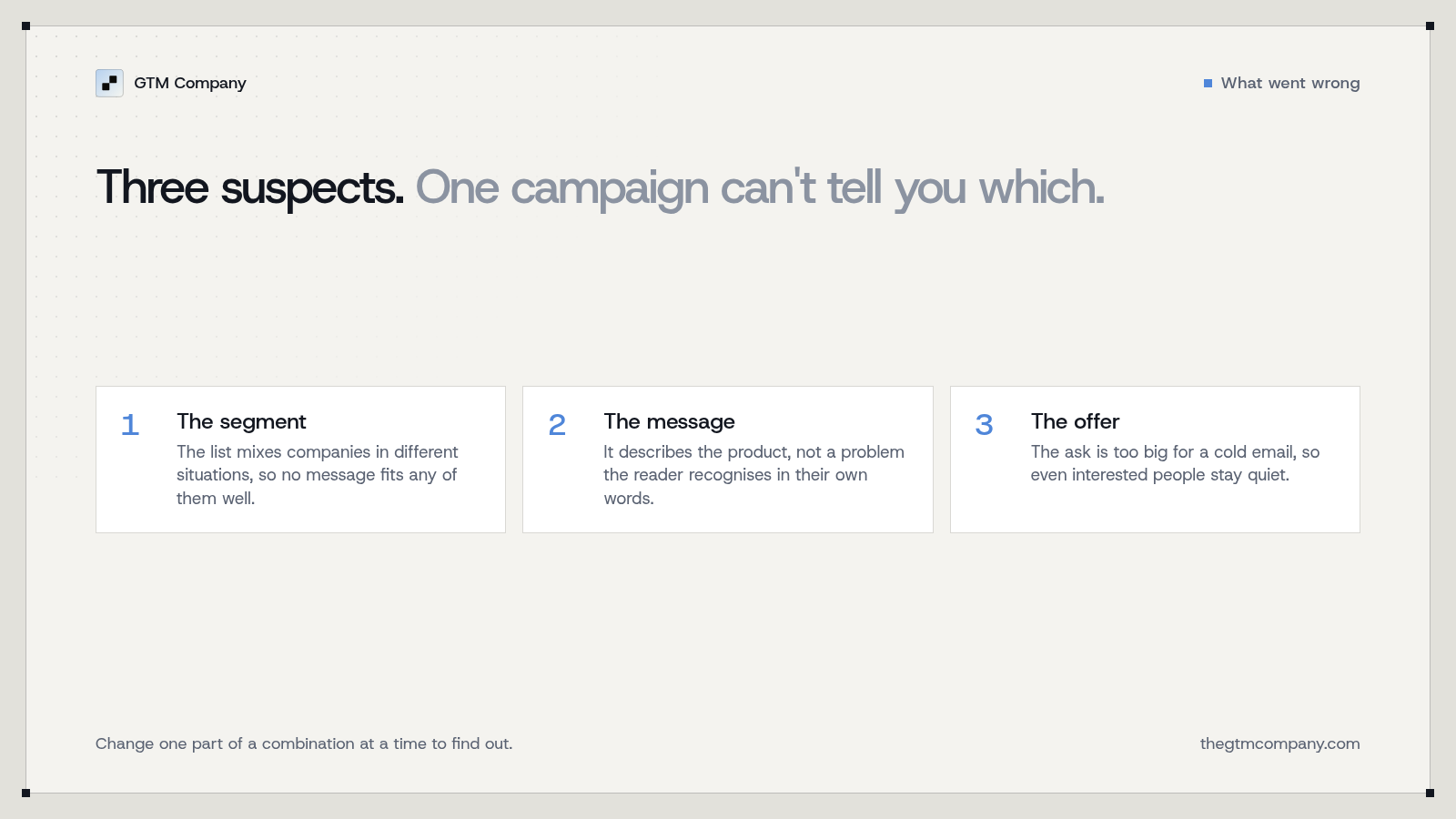
Any of three things could be wrong, and a single campaign can't tell you which:
- The segment. The list mixes companies in very different situations, so no single message fits any of them well.
- The message. It describes your product instead of a problem the reader recognises, in words they'd use themselves.
- The offer. The ask is too big for a cold email, so even interested people don't reply.
A worked example of a sample size of one
This is how it usually goes. This is an example, not a client story.
A founder selling scheduling software builds a list of 3,000 "operations" contacts at companies with 50 to 500 staff. One sequence of four emails goes out, about the product's features, ending with "worth a quick demo?". After four weeks there are six replies, two of them unsubscribes. The founder decides cold email doesn't work for the market.
Now look at what was in that list. Clinics with a no-show problem. Logistics firms juggling shift cover. Agencies booking client calls. Three groups with three different problems, all receiving the same email about features none of them asked about. The test didn't say the market won't answer cold email. It said this one email, sent to a mixed list, didn't land.
Split the same list into those three situations, give each a message about its own problem and a smaller first ask, and you have nine or more combinations to learn from instead of one.
A quick diagnostic for your last campaign
If you have the data, go back and check these.
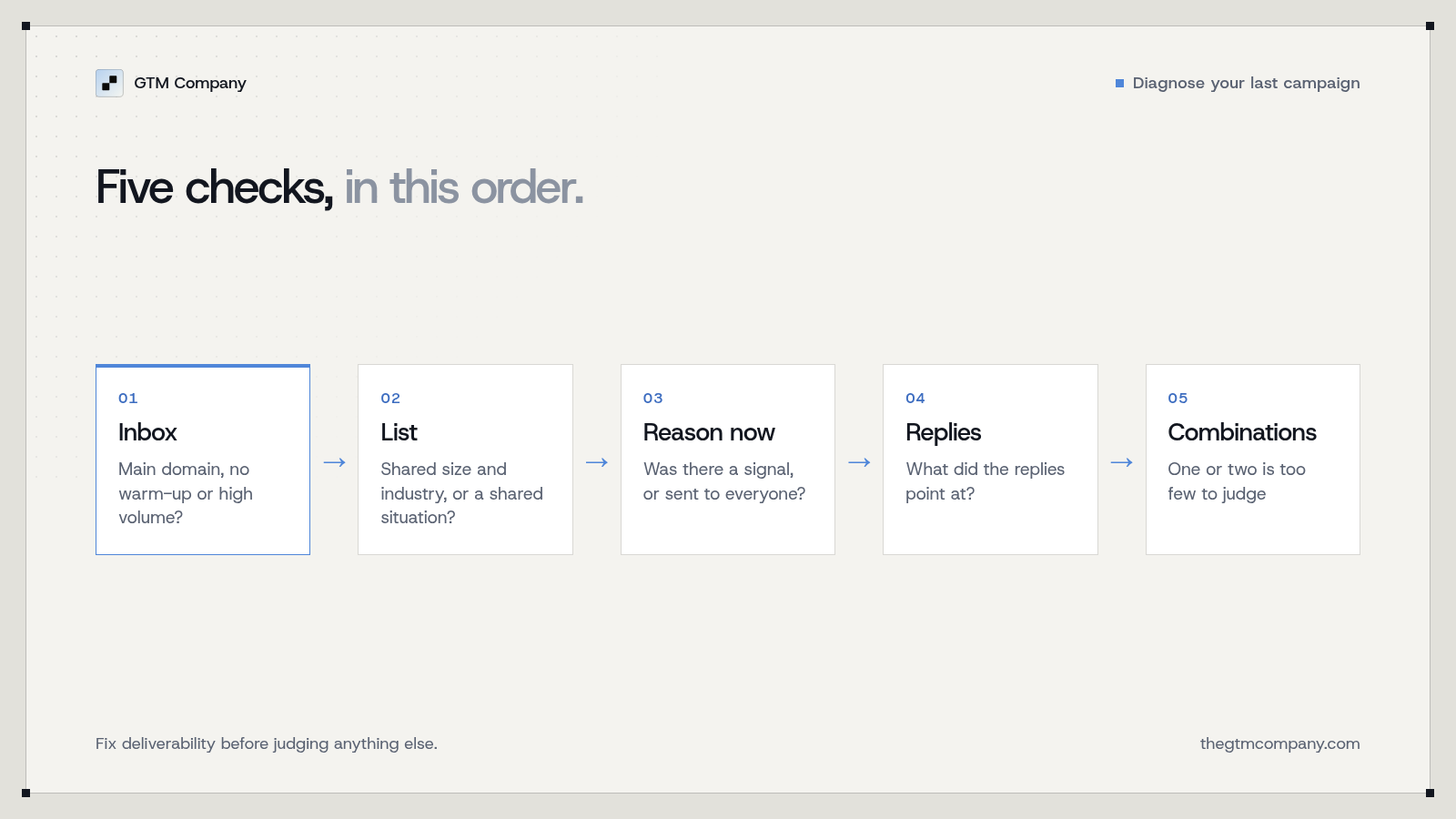
Did the emails land in the inbox? If you sent from your main domain, from new domains without warm-up, or at high daily volume per mailbox, a lot of your emails may never have been seen. Fix this before judging anything else.
How was the list built? If it was one big filter in a data tool, it was probably a set of companies sharing a size and an industry, not a situation. A good segment is a group with the same problem at the same time.
Was there a reason to email now? A signal, such as a new hire, a funding round, a tool change or a new market, gives the email a reason to exist. Without one, it reads like it was sent to everyone.
What did the replies say? Even negative replies tell you something. "Not relevant to us" points at the segment. "We already have this" points at the message. "Not now" can be about the offer or the timing.
How many combinations did you test? If the answer is one or two, the test was too small to say anything about the channel.
Reading the replies you did get
Replies are the cheapest research you'll ever get. Sort them into piles:
| What they said | What it usually points at |
|---|---|
| "Not relevant to us" | The segment |
| "We already have this" or "we use X" | The message |
| "Not now" or "maybe next quarter" | The offer or the timing |
| "Who are you?" or no context | The message, or a missing signal |
| Silence across the board | Deliverability first, then everything else |
What a proper test looks like
This is how we run it, so you can compare it with what you did before.
Start with research, not copy. We read your customer calls, your CRM, your competitors, and what your buyers say on Reddit and LinkedIn. The aim is to find the problems they describe in their own words.
Split the list by situation. We build segments of companies that share a situation, then look for signals that show a company is in that situation now.
Write in insider language. Each message is written for one segment, about a problem that segment has, in the words they use. A message about what keeps someone up at night beats one about your feature list.
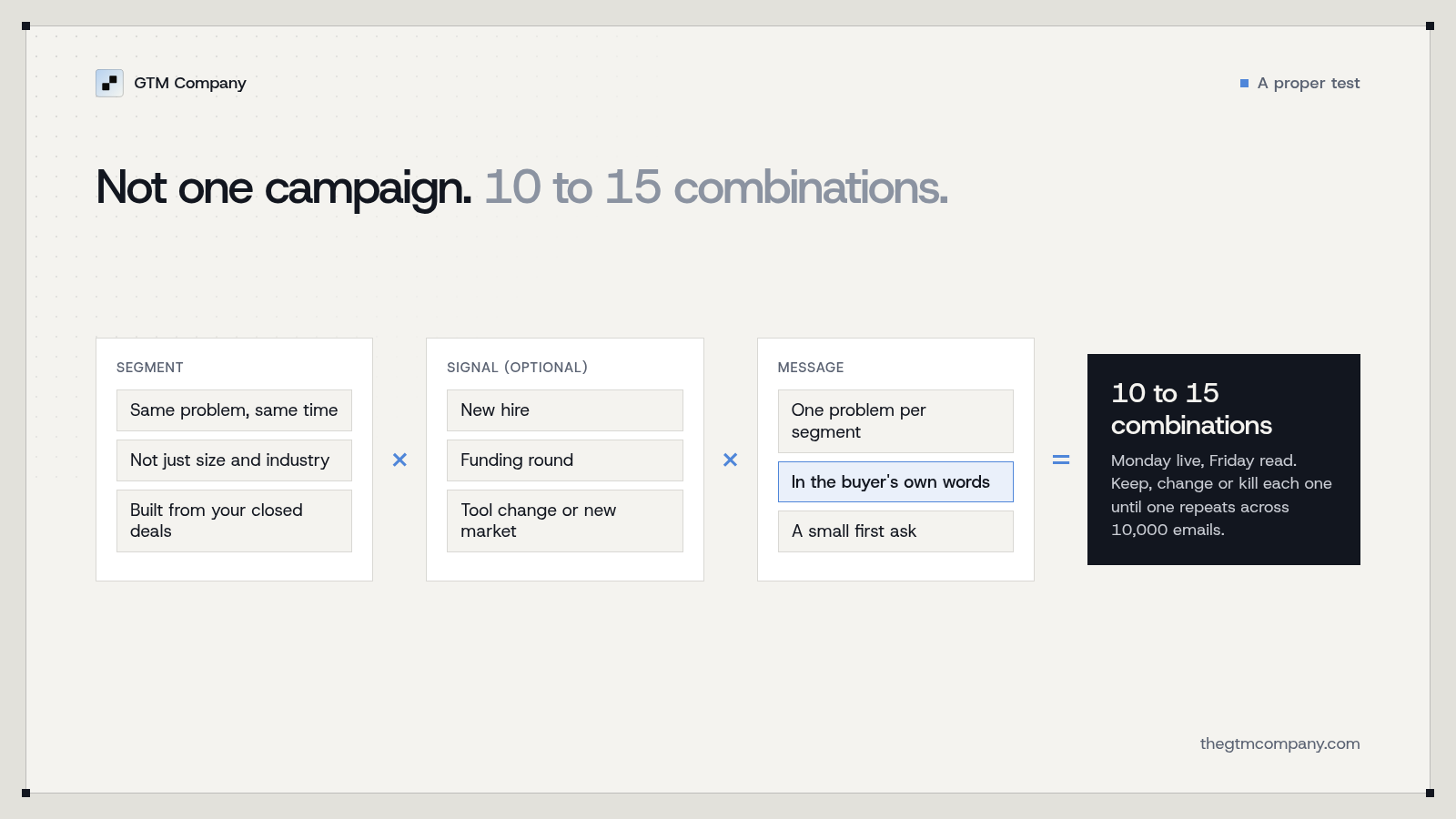
Run 10 to 15 combinations at once. Each combination is a segment, a signal and a message. Testing many at once is how you find a winner within weeks.
Read the replies every week. Live on Monday, read on Friday. We keep what works, cut what doesn't and write the next round from what came back.
Call a winner only when it repeats. A winning combination is one we can send 10,000 emails to and get predictable positive replies. Depending on the offer, that might be 1 positive reply in every 200 leads, or 1 in every 1,500.
The scale of the test matters. To read 10 to 15 combinations properly in a few months, you need somewhere around 20,000 to 60,000 emails a month. That's one reason so many in-house tests stall. I've covered the volume maths in running cold email in-house.
What this looks like in practice
One HR tech client came to us after 400 cold calls had booked a single meeting. They were getting one or two meetings a month. After we found the right message, outbound produced $6M in pipeline in six months.
A B2B SaaS founder community we worked with tested 20 different messages before one stood out. That winner was then scaled, and they went from $0 to $35K MRR in six weeks.
An AI customer support company started with us before it had revenue. Across more than 320 experiments, outbound booked 435 demos. The number that matters there is the 320. Most of those experiments didn't win, and each one narrowed down what did.
All three results came from testing until we found the message the market answered, not from sending more of the first campaign.
Re-running it yourself, step by step
If you want to try again before talking to anyone, this is the order I'd do it in.
- Fix deliverability. Separate sending domains, warmed for about two weeks, modest daily volume per mailbox.
- Pull your last ten closed deals. Write down what was happening at each company when it bought. That's your first set of situations.
- Turn each situation into a segment. Find more companies in the same situation, not only the same size and industry.
- Write one message per segment. About the problem, in the words your customers used on sales calls.
- Make the first ask small. A question or an offer to send something is easier to say yes to than a demo.
- Read every reply each week. Keep, change or kill each combination, and write down why.
Common mistakes when re-running a test
Changing everything at once. If you change the list, the copy and the offer in one go and it works, you won't know why. Change one part of a combination at a time and keep the others steady.
Judging on opens. Open tracking is unreliable and tells you little. Count positive replies per lead.
Stopping at week two. Warm-up takes about two weeks before the first send, and the first round is mostly about cutting losers. Most of the learning comes in the weeks after.
Writing more emails instead of better segments. A sixth follow-up rarely rescues a message the segment didn't care about.
Testing on your best accounts. If your market is small, don't burn your dream accounts on the first round. Test on the wider segment, then bring the winner to them.
Sometimes the earlier result was right. Cold email tends not to work when:
- your market has fewer than 5,000 target companies, so there aren't enough people to test on
- your ACV is low enough that even a good reply rate can't pay for the work
- you don't yet have a product with paying customers, so there's no proof to put in the message
If one of those applies, it's better to know before spending more. Is your market too small for cold email goes through the first one in detail.
FAQ
How many emails do I need before I can judge cold email? Enough to read each combination properly. A winner is judged across 10,000 emails to a segment, and running 10 to 15 combinations usually means 20,000 to 60,000 emails a month.
Can I re-use my old list? Often, yes, once it's split by situation. The list may not have been the problem. The way it was grouped usually was.
Was it my copy? Possibly, but check the inbox placement and the segment first. Good copy can't rescue emails nobody sees or a list with no shared problem.
Do I need a signal for every combination? No. A signal helps when there's a good one, but it's optional. A sharp segment with a message in its own language can work without one.
How do I know when to stop? When the research and testing show the market is too small, the ACV can't pay for it, or nobody in any segment responds after a proper test.
Before you write off the channel
If your last attempt was one list, one message and one offer, the channel hasn't been tested properly. If you'd like us to look at what you ran before and tell you what we'd change, book a call at thegtmcompany.com. If we think cold email won't work for you, we'll say so.