Three months is a real commitment, especially if you've signed with an agency before and regretted it. It's fair to ask why an outbound agency contract needs that long, and what protects you if it isn't working.
This post explains what the time is for, what should happen in each month, and what to look for in the contract so a three-month term doesn't mean three months of hoping. It finishes with the common mistakes founders make with agency terms and a short FAQ.
Why testing takes time
Finding a message your market answers is a search. You try combinations of segment, signal and message, read the replies, and change what isn't working. Two things set the pace.
Set-up comes first. New sending domains need about two weeks of warm-up before they can send at volume. Research, segments and copy approval happen in the same window. That's a good part of the first month gone before the first reply comes in.
Each combination needs enough sends to read. We want to see a combination hold up across about 10,000 emails before calling it a winner. Even at 20,000 to 60,000 emails a month spread across 10 to 15 combinations, that takes weeks per round.
Put those together and a single month is often enough to launch and get first signals, but not enough to know you've found something that repeats. Three months gives room for two or three rounds of changes after the first launch.
The arithmetic of a round
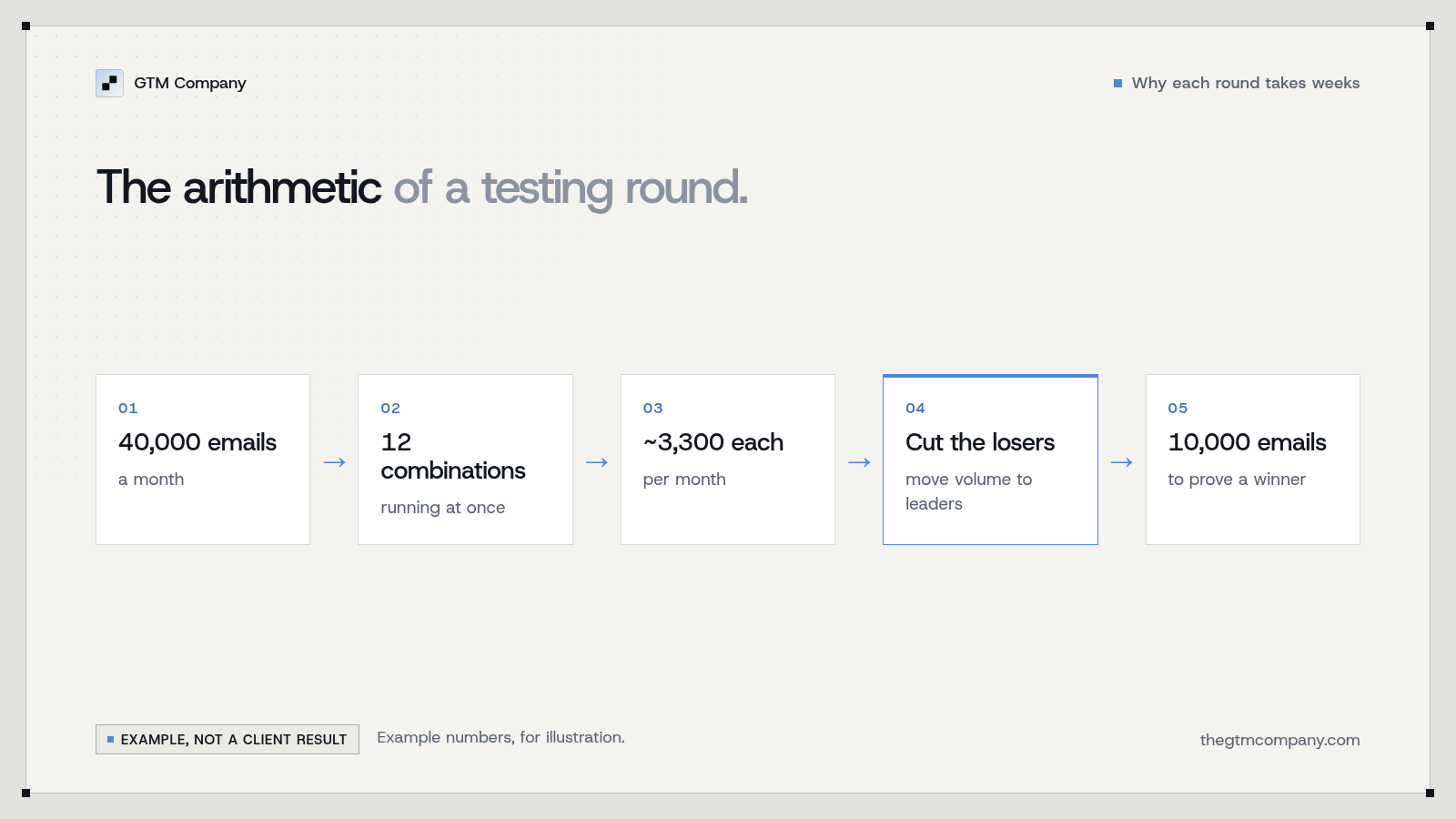
Why does each round take weeks? These numbers are an example.
- At 40,000 emails a month across 12 combinations, each combination gets roughly 3,300 emails a month.
- A combination needs about 10,000 emails to show it repeats.
- So even a strong combination takes around three months at that split to be proven, unless volume is moved towards it once it starts to lead.
That's what the weekly cycle is for. Losers are cut early, and their volume goes to the leaders, so the best combinations reach 10,000 emails sooner.
What should happen in each month
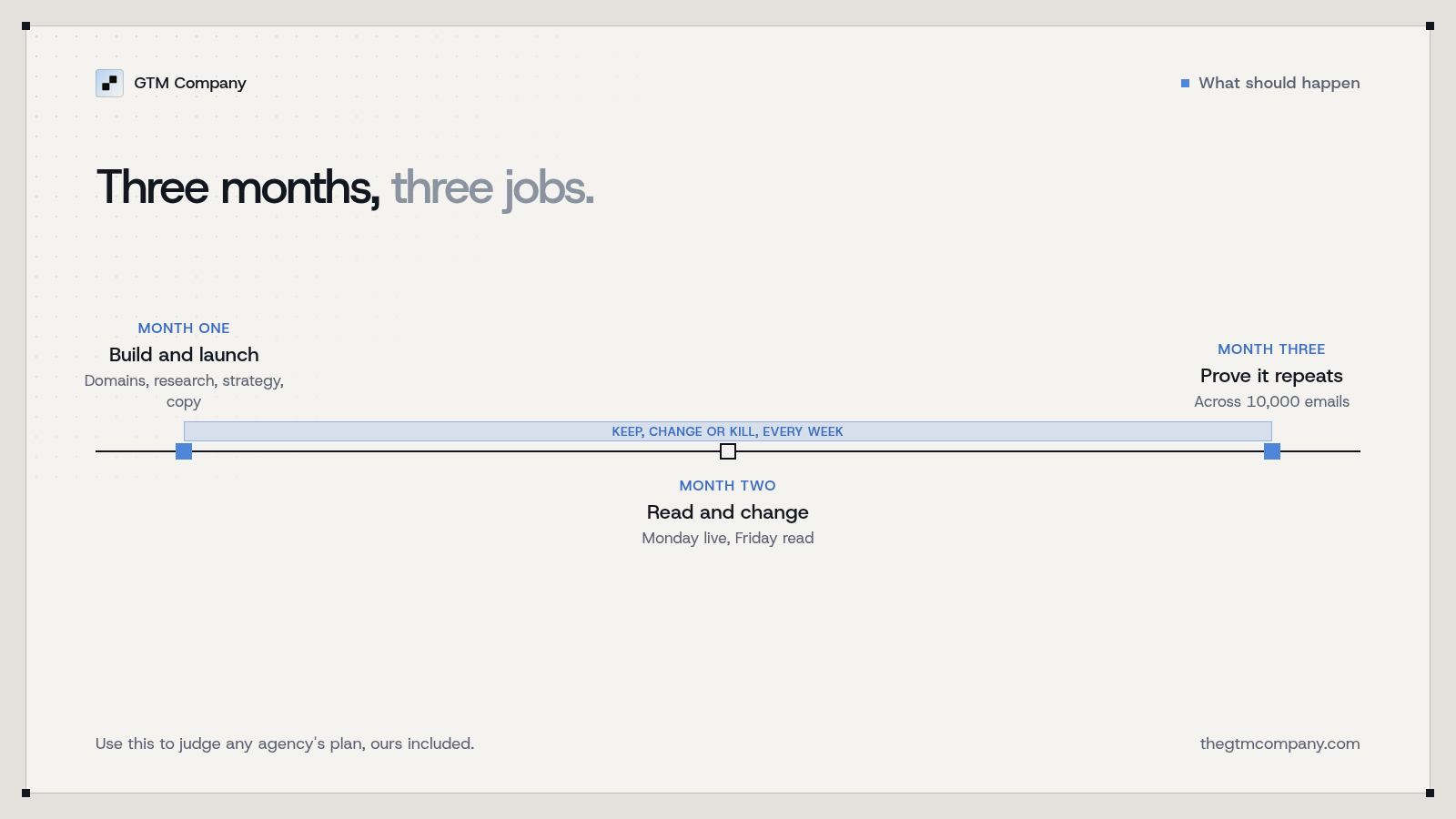
This is roughly what a three-month engagement should look like. Use it to judge any agency's plan, ours included.
Month one: build and launch. Domains bought and warming. Research into your calls, CRM, competitors and buyer conversations. Segments and signals agreed on a strategy call, along with the target that counts as a winning message. Copy written and approved. First sends in the second half of the month.
Month two: read and change. Combinations live on Monday, read on Friday, every week. Each one gets a decision: keep, change or cut. New versions are written from what the replies say. Leading combinations get more volume.
Month three: prove it repeats. The best combinations run across enough emails to show the result holds. You should leave with a clear view of which segment answers which message, at what rate.
If an agency can't describe its three months in this kind of detail, the contract length isn't the real issue.
What one founder community learned in six weeks
Not every engagement needs all three months to find a winner. One B2B SaaS founder community we worked with tested 20 messages before one stood out. That winner was scaled, and they went from $0 to $35K MRR in six weeks. Others take longer, which is why the term exists.
Two ways the same term can go
This is a made-up example to show the difference structure makes. Neither is a client.
Founder A signs a three-month term with an agency that sends one message to one broad list. Month one is set-up. Month two brings a handful of replies, most of them "not interested". In month three the agency changes the subject line. At the end of the term, Founder A knows the message didn't work but not why, and has nothing to take forward.
Founder B signs the same length of term with an agency that runs 12 combinations of segment, signal and message at once. By week six, four combinations have been cut and replaced. Two segments are replying, and one problem keeps coming up in the replies. In month three, most of the volume goes to the two leading combinations, and the Friday reports show whether the result holds. At the end of the term, Founder B has a message that works or a clear record of what to try next, plus the lists and replies.
Same length of contract. Very different value. The term isn't what made the difference; the structure inside it did.
Questions to ask before you sign
Put these to any agency, including us:
- What happens in each of the three months, week by week?
- How many combinations run at once, and at what volume?
- What counts as a winning message, and when do we agree it?
- What will each Friday report show?
- Whose accounts and domains does the work run in?
- What do we keep if the contract ends?
- What happens if you haven't found a winner by the end?
- What notice is needed to leave, and when can it be given?
If the answers are vague, a shorter contract won't fix that. If they're specific, three months stops feeling like a leap. There's a longer list in how to choose a cold email agency.
What protects you during the term
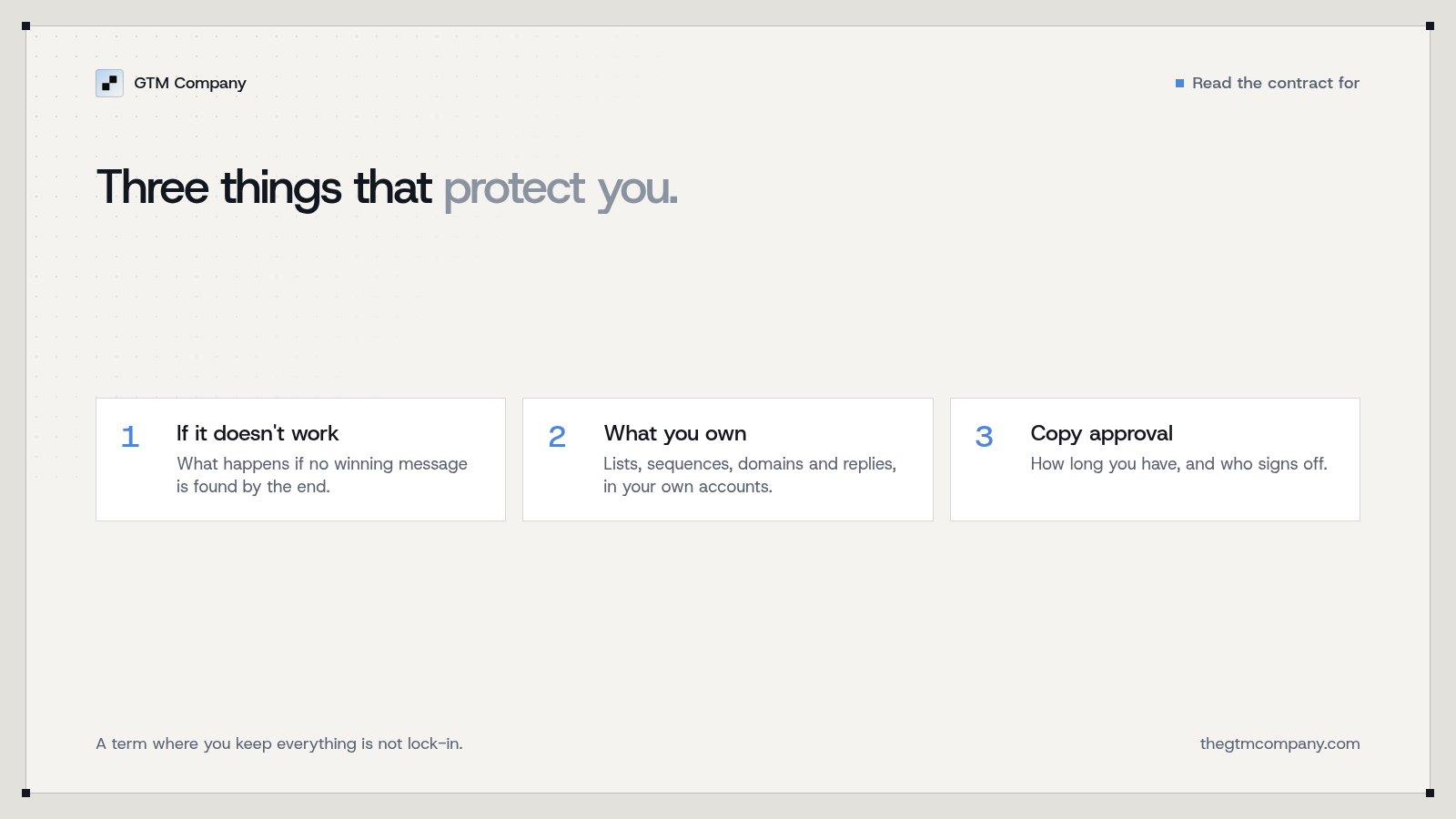
A long commitment is only a problem if you can pay for it and end up with nothing. Check the contract for three things.
What happens if it doesn't work. Ours: if we haven't found the winning message by the end of the three months, we keep running the process at no cost until we do. The reasoning is in why we don't guarantee meetings.
What you own. Lead lists should be yours once paid for, and the work should run inside your own accounts. With us, if we stop, you keep the lists, the sequences, the domains and every reply.
How fast you approve copy. Check how long the contract gives you to approve copy. Ours gives three business days. Late approvals push everything back, so agree who signs off before you start.
What you get even if it ends
Three months of structured testing leaves you with more than replies. You'll have a written record of which segments responded, which problems landed, which offers got ignored, and how each changed over time.
That's useful whatever you do next. You can run it in-house, hand it to an SDR, or use it in ads and on your website. The learning is yours either way.
If three months still feels too long
There are two ways to make the commitment feel smaller.
Start at lower volume. A smaller programme costs less per month. It also tests fewer combinations at once, so it may take longer to find a winner.
Agree the checkpoints in writing. Set what you'll see in week two, week six and week twelve, and what result would make you want to carry on. Having that on paper makes the decision at the end of the term a lot easier, whichever way it goes.
What the weekly reports should show you
The term is easier to judge if you know what each Friday should tell you. A useful report covers:
- the outliers: combinations doing much better or worse than the rest
- the sentiment of the replies, not only the count
- the meetings booked, and from which combinations
- a decision for each combination: keep, change or kill, with the reason
By week six you should be able to read three or four reports in a row and see the thinking change. If the reports look the same every week, the work probably does too.
Common mistakes with agency terms
Judging the term by month one. Month one is mostly set-up and first launch. Judge it on whether the work happened on time, not on revenue.
Not reading the exit clause. Know what notice is needed and when it can be given before you sign, not when you want to leave.
Signing without knowing who approves copy. Late approvals are the most common reason a launch slips. Name the person and the turnaround.
No written checkpoints. "We'll see how it goes" makes the end of the term a matter of opinion. Write down what result would make you carry on.
Confusing commitment with lock-in. A three-month term where you keep the lists, the domains and every reply is very different from one where you leave with nothing.
FAQ
Why not month to month? Because the first month is mostly set-up. A month-to-month deal tends to get judged before any combination has had enough sends to read.
What if we find a winner in month one? Then the rest of the term goes into proving it repeats and getting it ready to scale.
What do we have at the end? A written record of what was tested, what worked and what didn't, plus the lists, sequences, domains and replies, all in your accounts.
Is three months the same for every market? Smaller markets may need lower volume, which can make each round slower. I've written about that in is your market too small for cold email.
Ask the same questions of everyone
Whoever you sign with, ask what happens in each month, what you keep, and what happens if they don't find a working message. If you'd like to see how we'd plan the three months for your market, book a call at thegtmcompany.com.