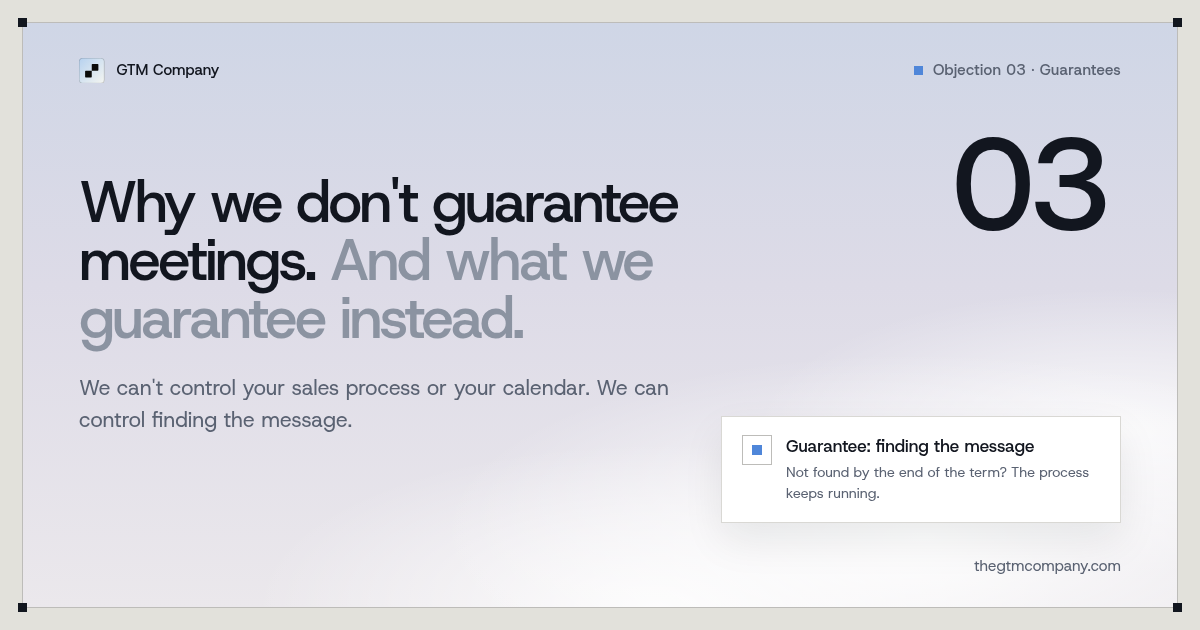
"Can you guarantee meetings?" is one of the most common questions founders ask us, and it's a fair one. You're about to spend money on a channel that may have let you down before, and you want someone else to carry the risk.
Our answer is no. We don't guarantee meetings, because we can't control your sales process or your calendar. What we guarantee instead is the thing we do control, and I think it's a better deal for you.
This post explains both. It covers what a meeting guarantee asks an agency to control, where those guarantees usually hide the catch, what we guarantee and how it's measured, what any guarantee should ask of you, and the questions to put to an agency before you rely on its promise.
What a meeting guarantee asks an agency to control
A booked meeting that turns into revenue depends on a lot of things working at once:
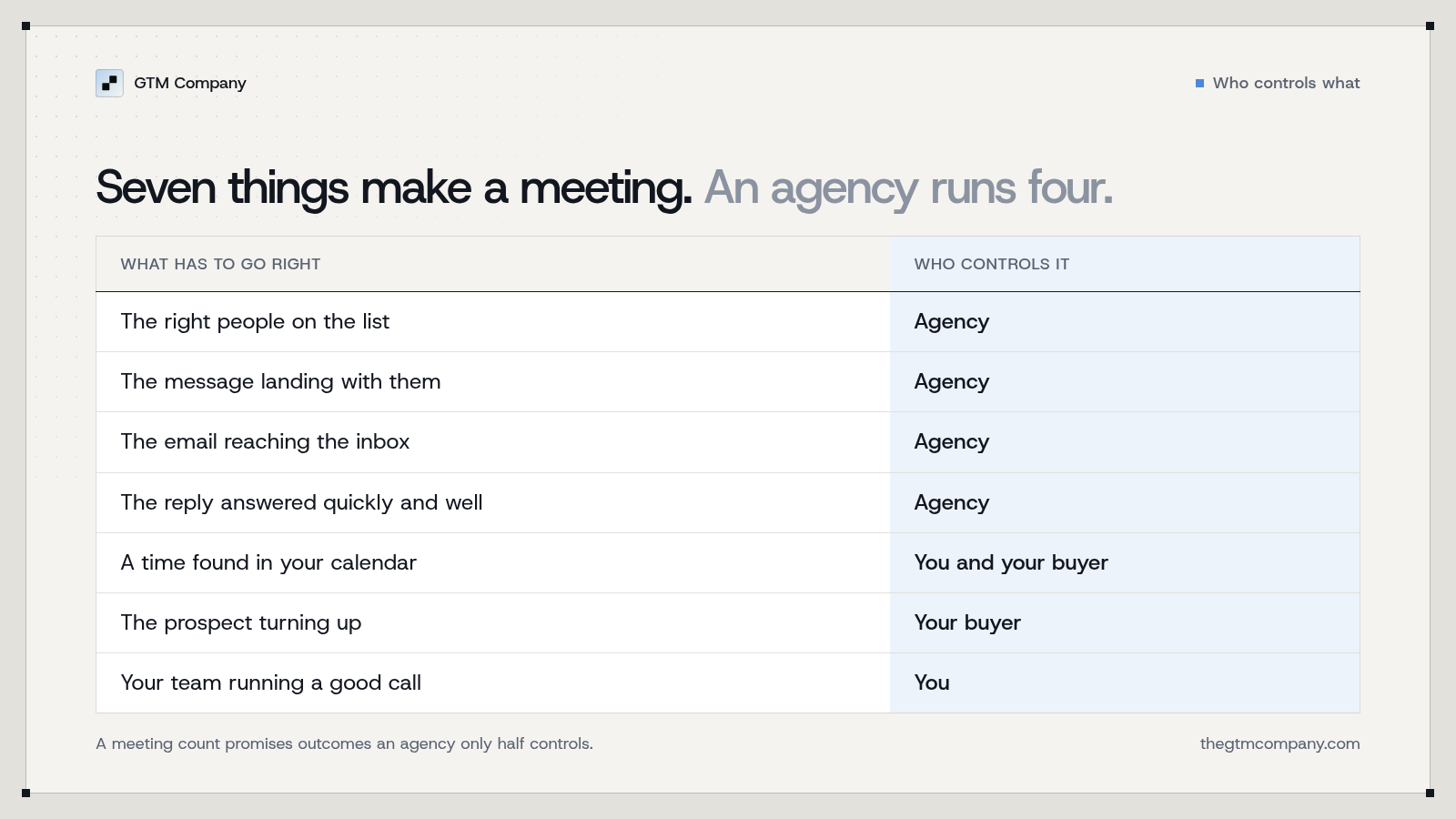
- the right people being on the list
- the message landing with them
- the email reaching the inbox
- the reply being answered quickly and well
- a time being found in your calendar
- the prospect turning up
- your team running a good call
An agency runs the first four. The last three sit with you and your buyer. An agency promising a fixed number of meetings is promising outcomes it only half controls, so it has to protect itself somewhere. Usually that protection sits in the small print.
There's a second problem. Even within the first four, an agency can't know at the start how your market will respond. Nobody does. The whole point of the first few months is to find out. A fixed meeting number set before that work starts is a guess, and someone pays for it being wrong.
Where meeting guarantees hide the catch
If you're comparing agencies that do offer one, read the terms for these.
What counts as a meeting. Is it any booked call, or a call with a named job title at a company in your ICP who turns up? A loose definition makes the guarantee easy to hit and worth little to you.
What happens if they miss. A partial refund, a free extra month, or more of the same sending? A free month of a campaign that isn't working doesn't solve anything.
What it does to the targeting. When the guarantee is a count, the easiest way to hit it is to widen the list and soften the ask. You get more meetings and fewer buyers. I've gone into the incentives in more detail in pay-per-meeting lead generation.
What it does to learning. An agency chasing a number has every reason to keep sending whatever books calls fastest, and little reason to test anything that might miss for a week. You end the term with a meeting count and no idea what your market responds to.
You'll also notice that most agency contracts, ours included, say plainly that they don't warrant a specific number of leads, meetings or revenue. The headline promise and the contract don't always match, so read both.
A worked example of how the incentive plays out
Picture two agencies with the same sending volume and the same client, a B2B SaaS company selling to operations leaders at mid-sized firms. This is an example, not a client story.
The first agency has guaranteed ten meetings a month. In week two it sees that a broad list of anyone with "operations" in their title books more calls than the narrow list of the people who buy. It keeps the broad list. The client gets its ten meetings. Half are with people who can't sign. The close rate drops, and by month three the client is asking why the meetings don't turn into revenue.
The second agency has guaranteed nothing about meetings. It's measured on finding a combination that returns a predictable number of positive replies from the people who buy. In week two it sees the same thing, and it cuts the broad list because the replies come from the wrong people. It books fewer meetings in month one. By month three it has a narrower segment and a message that repeats, and every meeting from that combination is with a likely buyer.
The first agency met its promise. The second gave the client something to build on. That's the difference I care about.
What we guarantee instead
We guarantee the part that is ours to do: finding the message your market answers.
That needs a definition, so here is ours. A winning message is a combination of segment, signal and message where we can send 10,000 emails to a segment and get back a predictable number of positive replies. The target depends on the offer. For one client it might be 1 positive reply in every 200 leads, for another 1 in every 1,500. The point is that the result repeats, so you can plan around it.
To get there we run a fixed process:
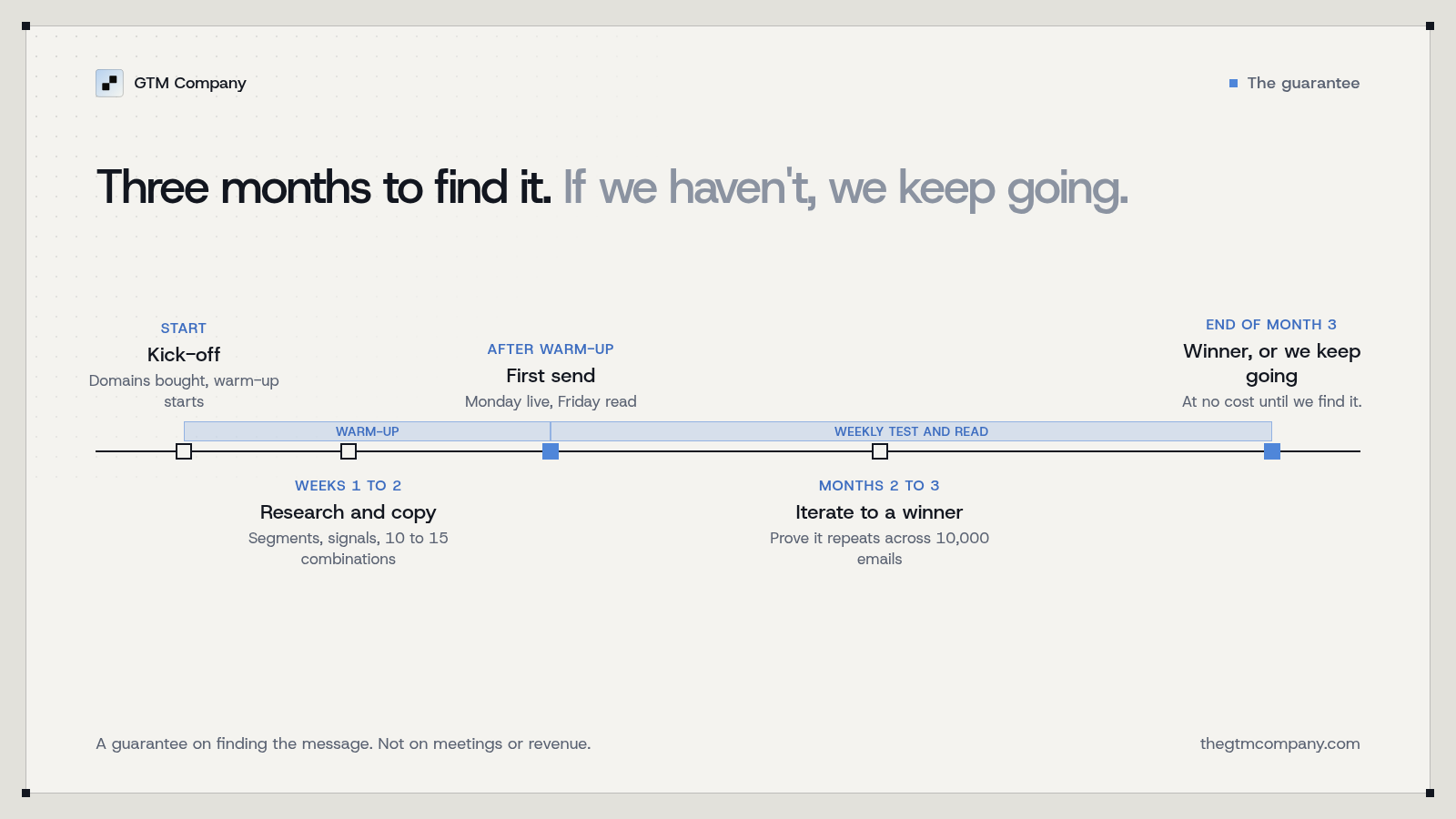
- Research the market from your customer calls, CRM, competitors and the conversations your buyers have online.
- Split the market into segments that share a situation.
- Build 10 to 15 combinations of segment, signal and message.
- Send them, live on a Monday and read on a Friday, every week.
- Read every reply for sentiment and track how many become meetings.
- Keep changing segment, signal and message until one combination wins, then prove it repeats across 10,000 emails.
If we haven't found the winning message by the end of the three-month term, we keep running the process at no cost until we do.
Why this is the better guarantee for you
A meeting guarantee pays you back for a bad quarter. A message guarantee keeps the work going until you have the asset that makes every later quarter predictable.
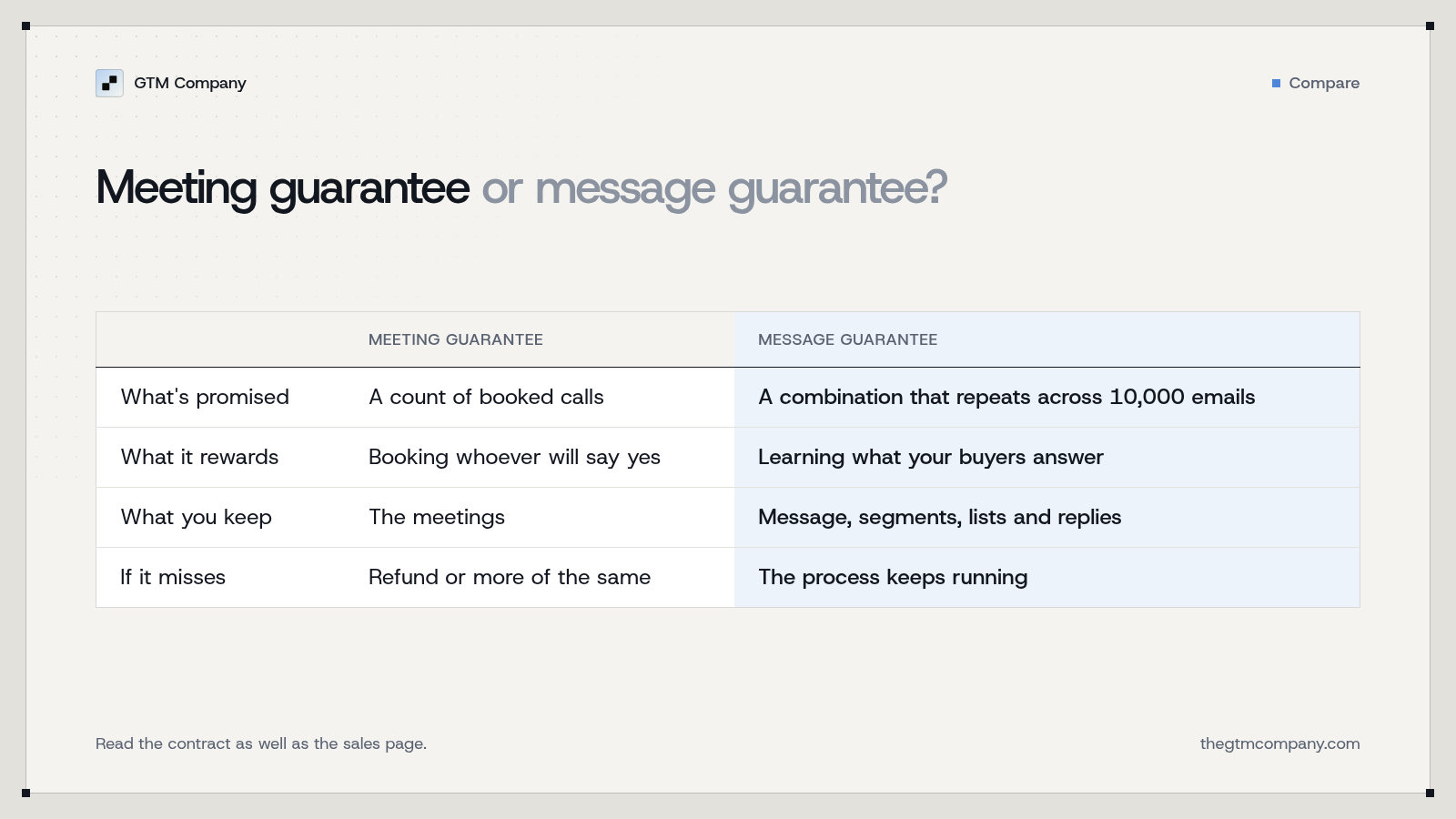
| Meeting guarantee | Message guarantee | |
|---|---|---|
| What's promised | A count of booked calls | A combination that repeats across 10,000 emails |
| What it rewards | Booking whoever will say yes | Learning what your buyers answer |
| What you keep | The meetings | The message, segments, lists and replies |
| If it misses | Refund or more of the same | The process keeps running |
Once you know which message a segment answers, the meetings follow from volume. You can scale it, hand it to an SDR, use it in your ads, or keep it running with us. Without it, every meeting is a one-off.
It also keeps both sides honest. You can see the work every week: which combinations are live, what came back, and what we decided for each one. And because everything runs in your own accounts, you keep the lists, the sequences, the domains and every reply, whatever happens.
What you see each week while we look
A guarantee on the work only means something if you can see the work. Every Friday you get a report covering the outliers in the data, the sentiment in the replies, the bookings, and the decision we've made for each combination: keep it, change it or kill it.
That rhythm is what makes the guarantee checkable. By the end of month one you should be able to point at the combinations that were cut and say why. By the end of month two you should see one or two pulling ahead. If you can't follow the reasoning from the reports, ask. You're paying for the thinking as much as the sending.
When a meeting guarantee does make sense
I don't think meeting guarantees are always wrong. Once you know what to say and who to say it to, paying per meeting can be a fair deal, because the price can be set on economics you've seen rather than guessed. The problem is buying one before that point, when you're paying per meeting for a message nobody has tested.
What the work needs from you
Finding the message depends on both sides. The research is built from your customer calls, CRM and customer list, so the sooner those arrive, the sooner it starts. Segments and offers get agreed on the strategy call, so the person who signs off on messaging needs to be there. Copy approval sits with you, and a late approval moves the launch. A do-not-contact list before launch keeps your current customers out of the sends.
When you read any agency's guarantee, look at what it asks of you as well as what it promises. A guarantee that asks nothing of you probably isn't protecting you either, and the list of what it does ask is a useful preview of where the work will depend on you.
Common mistakes when comparing guarantees
Comparing headline numbers. "20 meetings guaranteed" sounds better than "we'll find your message". Read what counts as a meeting and what happens on a miss before you compare.
Ignoring what you keep. A guarantee that ends with you owning nothing is weaker than it looks, however generous the refund.
Assuming the sales page is the contract. Ask for the contract wording. If the two don't match, the contract wins.
Forgetting the conditions. If a guarantee has conditions and you can't meet them, for example because nobody can approve copy within a few days, the guarantee won't apply. Better to know that before you sign.
Questions to ask about any guarantee
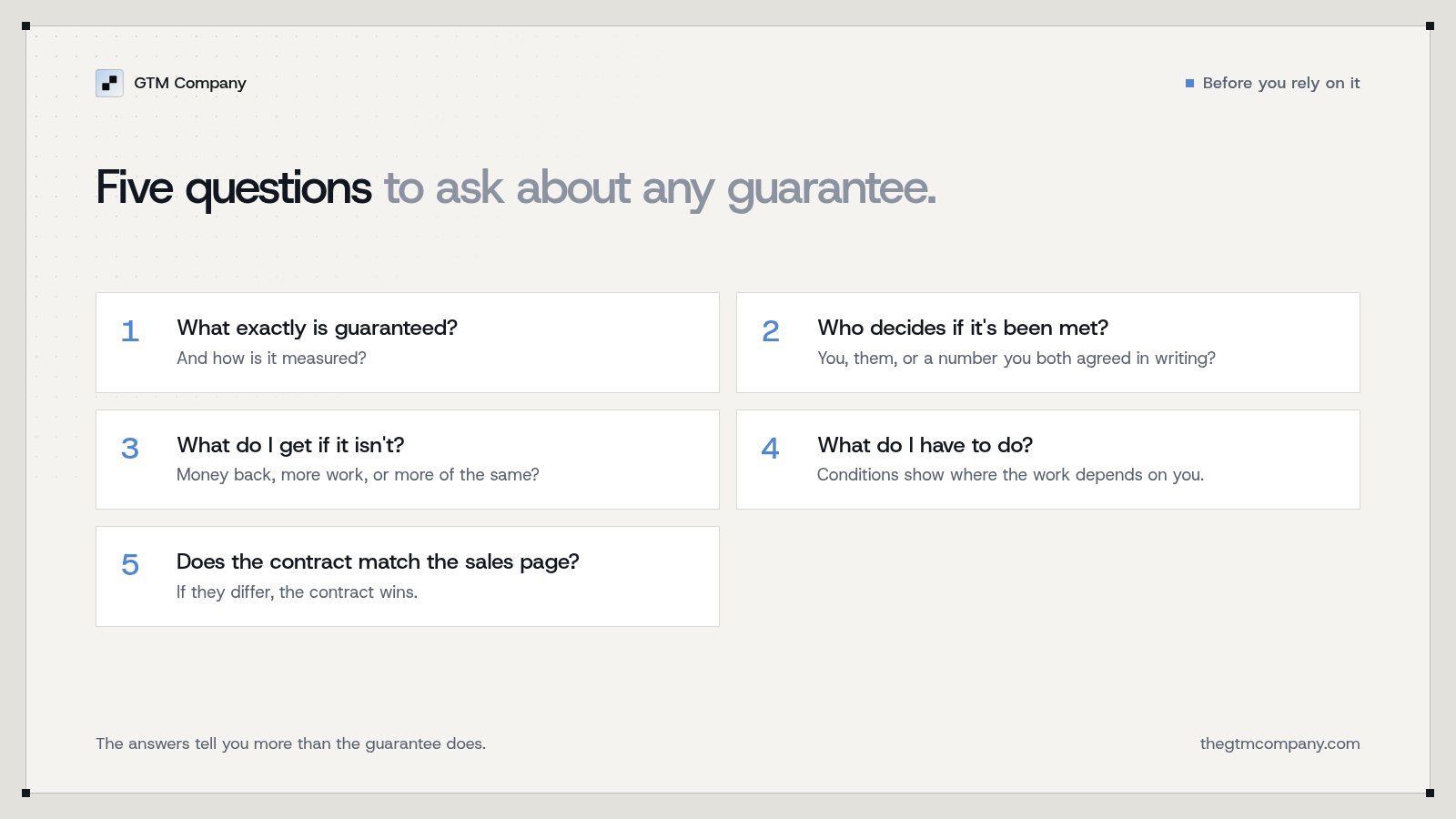
- What exactly is guaranteed, and how is it measured?
- Who decides whether it's been met?
- What do I get if it isn't: money back, more work, or something else?
- What do I have to do for it to apply?
- Does the contract say the same thing as the sales page?
The answers will tell you more about an agency than the guarantee itself. If you're comparing several, I've put together seven more questions in how to choose a cold email agency.
FAQ
Do any cold email agencies guarantee meetings? Some do. Read what counts as a meeting, what happens if they miss and what their contract warrants. Many contracts disclaim specific outcomes even when the sales page promises them.
Isn't a guarantee on finding the message vague? Not if it's defined. Ours is measured as a predictable number of positive replies per 10,000 emails to a segment, with the target agreed for your offer.
Why not guarantee positive replies instead? In effect that's what the definition does, but the target depends on your market and offer, so it's set for you rather than promised in advance.
What if we find the message in month one? Then you have it early, and the rest of the term goes into proving it repeats and preparing to scale it.
Does the guarantee change how long I'm committed for? The term is three months. I've written about what that time buys in is a three-month outbound contract too long.
Talk it through
If you'd like to see how we'd define a winning message for your market, and what we'd need from you, book a call at thegtmcompany.com. We'll give you a straight answer on whether you're a fit.