Pay-per-meeting lead generation looks like the safest way to buy outbound. You only pay when a meeting lands in your calendar. If nothing happens, you've lost nothing.
We get asked for it often, and we say no. That isn't because pay-per-result can never work. It works well in one situation and badly in the one most early-stage SaaS founders are in. This post explains the difference, so you can decide for yourself.
It covers what the agency is paid to do under each model, why the price is a guess at the start, how to work out what a meeting is worth to you, the three conditions that make pay-per-meeting sensible, what to check if you sign one, and the mistakes I see founders make when comparing the two.
Why it looks risk-free
The appeal is clear. You've maybe paid a retainer before and got very little for it. Paying per result moves the risk onto the agency, and if the agency is confident, why wouldn't it agree?
The catch sits in the incentives and in the price.
What the agency is paid to do
An agency paid per meeting earns money by booking as many meetings as it can. Who buys afterwards is your problem.
That shapes every decision it makes:
- The list gets wider. The more people contacted, the more meetings booked, whether or not they fit.
- The message gets safer. A broad, low-commitment ask books more calls than a sharp one aimed at a single segment, even if the sharp one would bring in better buyers.
- Learning stops being useful to them. Working out which segment buys, and why, takes effort that doesn't raise the meeting count this month.
- The assets stay with them. The lists, the copy and what they learned about your market usually stay with the agency when the deal ends.
None of this needs bad intent. It's what the contract pays for.
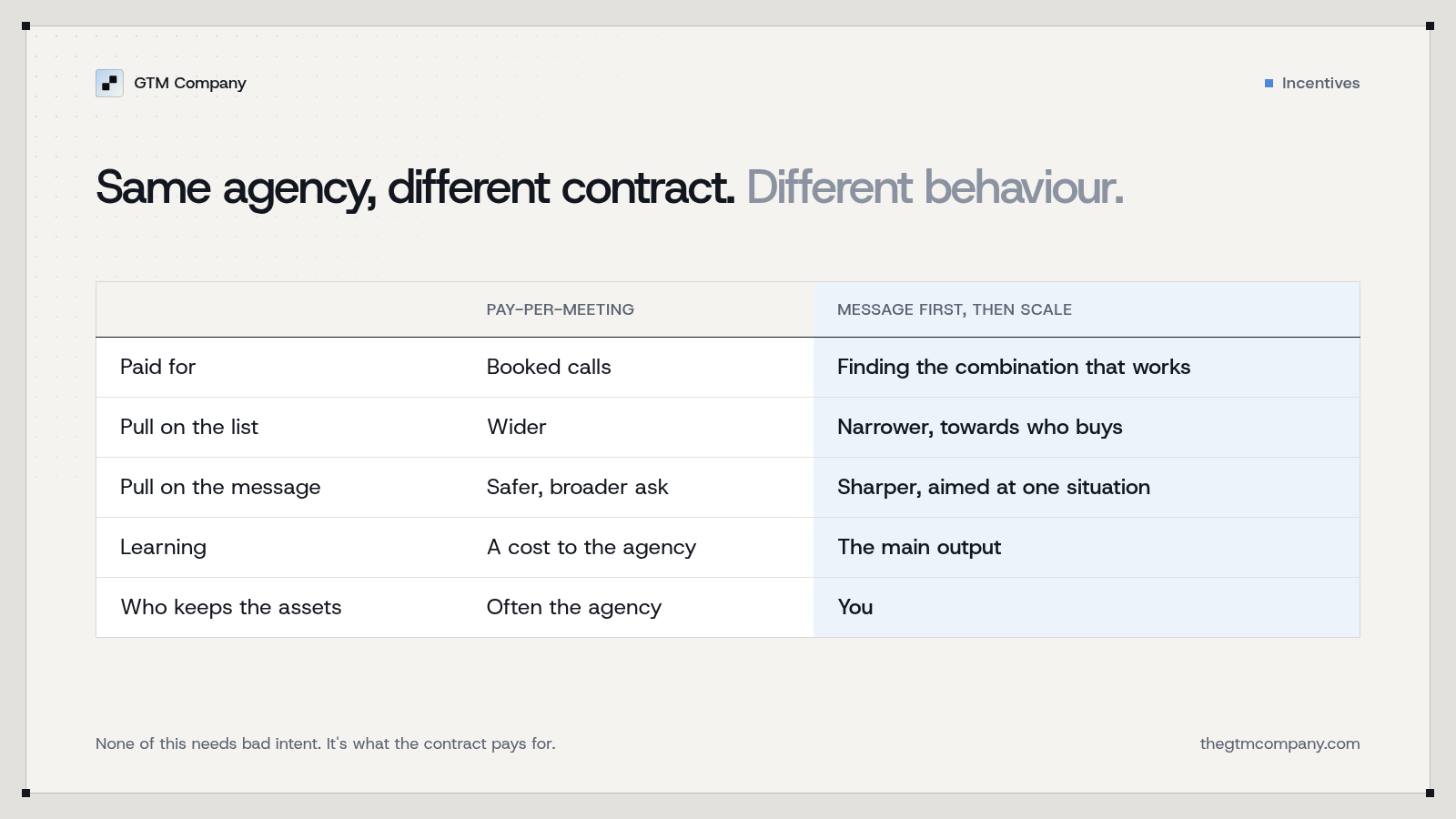
| Pay-per-meeting | Message first, then scale | |
|---|---|---|
| Paid for | Booked calls | Finding the combination that works |
| Pull on the list | Wider | Narrower, towards who buys |
| Pull on the message | Safer, broader ask | Sharper, aimed at one situation |
| Learning | A cost to the agency | The main output |
| Who keeps the assets | Often the agency | You |
The pricing problem
A pay-per-meeting price is set before anyone knows the economics of your market. Nobody knows yet how many emails it takes to book a meeting with your buyer, or how many of those meetings close.
So one side is guessing. If the agency guesses high, you overpay for every meeting. If it guesses low, the agency loses money and stops putting effort in, or quietly drops the quality bar. That's why we say no at the start of an engagement. One of us would be guessing at the price.
A worked example of the guess
This is how the guess plays out. This is an example, not a client story.
A founder selling workflow software to finance teams agrees a per-meeting price with an agency. Neither side knows how the market will respond. In month one the agency finds that finance directors at its target companies barely reply, but junior analysts book calls happily. The analysts can't buy.
Now the agency has two choices. It can keep chasing finance directors, book very few meetings and lose money on the deal. Or it can book the analysts, hit its numbers and get paid. The contract rewards the second choice, and the founder ends up paying for meetings that were never going to close.
If the agency had guessed the other way, and priced high to cover the risk, the founder would have overpaid for every good meeting instead. Either way, someone pays for not knowing the economics yet. That's the problem a test phase is there to solve.
When pay-per-meeting does make sense
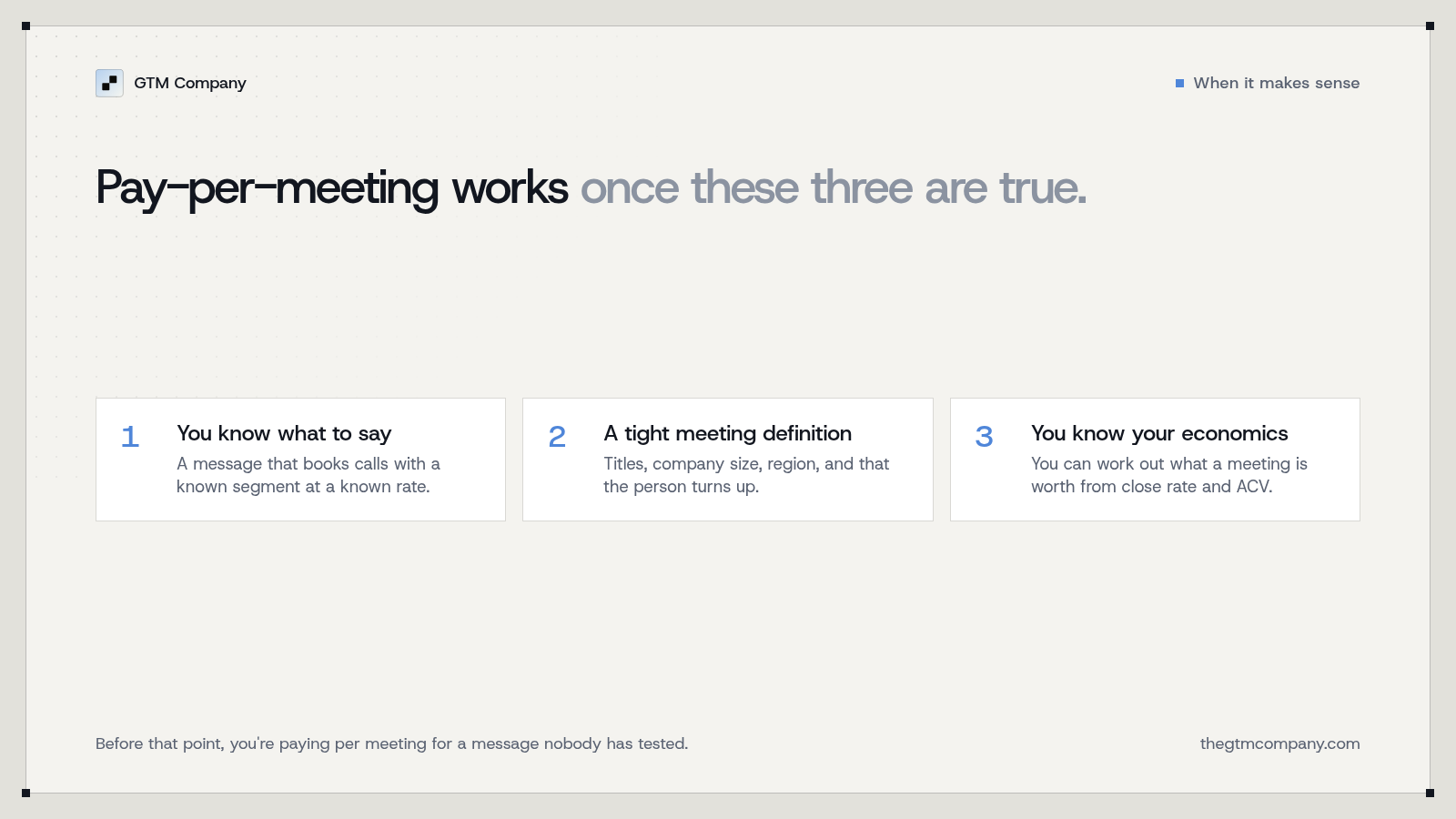
Pay-per-meeting can work well once three things are true.
- You already know what to say. You have a message that books calls with a known segment at a known rate.
- You can define a qualified meeting tightly. Job titles, company size, region, and that the person turns up.
- You know your own economics. You can work out what a meeting is worth from your close rate and ACV, so you can tell whether the price per meeting makes sense.
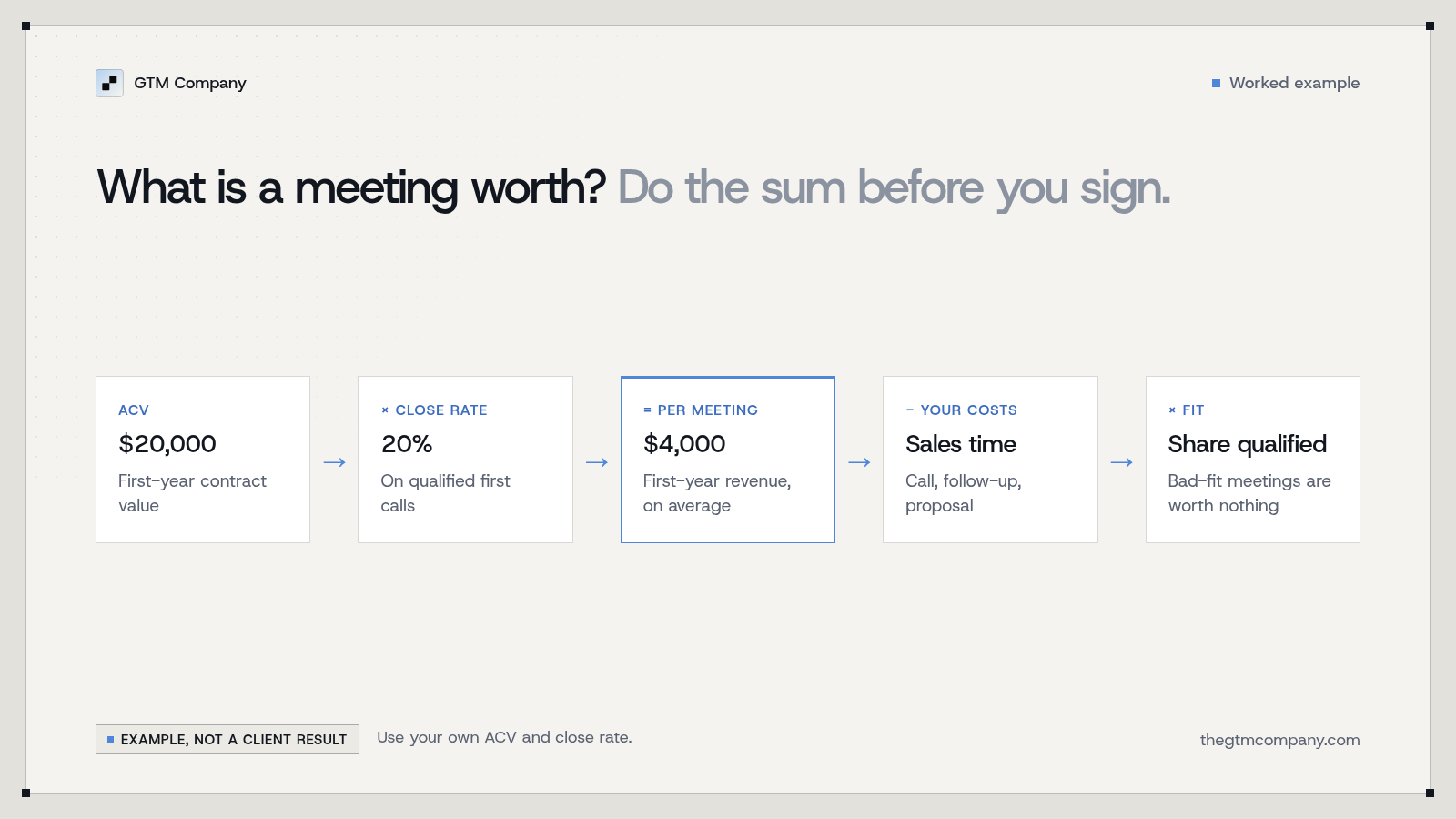
The third point is simple maths. A qualified meeting is worth roughly your ACV multiplied by your close rate on qualified calls. With a $20,000 ACV and a 20% close rate, a meeting is worth about $4,000 in first-year revenue before your sales costs. If you can't do that sum with real numbers yet, you can't judge whether $300 or $800 a meeting is a good price, and neither can the agency. (Those figures are only there to show the sum. Use your own.)
How to work out what a meeting is worth to you
Here is the sum step by step, so you can run it on your own numbers before you talk to any agency. The figures below are an example, not a client result.
- Start with your ACV. Use the average first-year contract value for the customers you'd want more of, not your overall average if it's skewed by a few large deals. Example: $20,000.
- Take your close rate on qualified first calls. Use the rate for meetings that came from outbound if you have it, because inbound meetings usually close better. Example: 20%.
- Multiply them. That's the first-year revenue a qualified meeting is worth on average. Example: $20,000 × 20% = $4,000.
- Take off what the meeting costs you to run. Your team's time on the call, the follow-up and the proposal. You know that number better than anyone.
- Adjust for bad fit. If one in three booked meetings is with someone who can't buy, the value of the average booked meeting drops by a third.
Step five is where pay-per-meeting deals usually go wrong. The price is per booked meeting, but the value only comes from qualified ones. The looser the definition, the bigger the gap.
of a known play, and paying per unit of output is reasonable. Before that point, you're paying per meeting for a message nobody has tested.
If you sign one anyway, check these
- The meeting definition, in writing. Who counts, who doesn't, and what happens with no-shows.
- Who owns the lists, copy and domains. If you leave, what do you keep?
- What you learn. Will they tell you which segments and messages booked the meetings that closed?
- A cap. What's the most you could pay in a month if they book a lot of poor-fit calls?
- Your sales time. Every bad-fit meeting costs your team an hour. Count that in the price.
Common mistakes when comparing the two
Comparing price per meeting with a monthly fee. A per-meeting price only looks cheaper if you assume the meetings are as good as the ones you'd get from a tested message. Compare cost per qualified meeting that closes, not cost per calendar entry.
Leaving out your sales time. Every poor-fit meeting takes an hour of a founder's or account executive's time, plus prep. That cost is real even if it never shows up on an invoice.
Forgetting the exit. At the end of a pay-per-meeting deal, ask what you'll know about your market that you didn't know before. If the answer is nothing, you've rented meetings.
Signing before you can do the sum. If you can't yet say what a meeting is worth to you, you can't tell whether the price is fair. That's a sign you need to find the message first.
What we do instead
We find the message first. We test 10 to 15 combinations of segment, signal and message, read every reply each week, and keep what books calls with the right people. Once a combination works, every meeting after that gets cheaper, whoever books it.
The risk is still there, but it sits somewhere that suits you better. We guarantee the work. If we haven't found the winning message by the end of the three-month term, we keep going at no cost until we do. I've explained that in full in why we don't guarantee meetings.
What we find stays with you. Lead lists are yours once paid for, and everything runs inside your own accounts. If we stop working together, you keep the lists, the sequences, the domains and every reply.
Moving from one model to the other
Nothing stops you changing how you pay once the message is known. When a combination has repeated across 10,000 emails, you know the reply rate, the booking rate and, after a few weeks, the close rate. That's the information a fair per-unit price needs. Whether you keep running it with us, take it in-house or hand it to an SDR, you'll be setting the price on numbers you've seen.
Where pay-on-results does belong
Pay-on-results terms can still be useful in outbound, pointed the other way. As part of testing offers, we sometimes test guarantees, trials or pay-on-results terms as something you offer your own buyers. A strong risk reversal in your offer can be the thing that gets a cold prospect to take the call.
That's a test about what makes your buyers say yes, and it's a different decision from how you pay an agency.
FAQ
Is pay-per-meeting ever cheaper? It can be, once the message is known and the meeting definition is tight. Before that, the price is a guess, and one side pays for the guess being wrong.
Do you offer pay-per-meeting at all? Not at the start of an engagement, because one of us would be guessing at the price.
What does a retainer protect me from? Paying for meetings with people who can't buy, and ending the term with nothing you own. You keep the lists, the sequences, the domains and every reply.
How do I know the retainer isn't money for nothing? Ask to see the work each week. Ours comes as a Friday report with outliers, reply sentiment, bookings and a decision for each combination. If an agency can't show you that, be wary of either model.
What should a meeting definition include? Job title or function, company size, region, a link to your ICP, and what happens with no-shows and reschedules.
The short version
Pay-per-meeting suits a company that already has message-market fit and wants more of the same. If you haven't found the message yet, pay for the search, make sure you own what it finds, and switch to paying per unit later if that's what you want. If you're not sure which one you are, why your cold email didn't work is a good place to check.
If you'd like a straight read on where you are, book a call at thegtmcompany.com.