"For that money I could hire an SDR." It's a sensible thought. An SDR is a person on your team, working only for you, and they can email, call and follow up. An agency can look expensive next to that.
I think hiring an SDR is often the right move. The question is when. This post covers what an SDR costs in full, what they need from you to succeed, and how to decide which comes first. There's also a checklist for handing a message to an SDR, the mistakes I see most often, and a short FAQ.
What an SDR costs
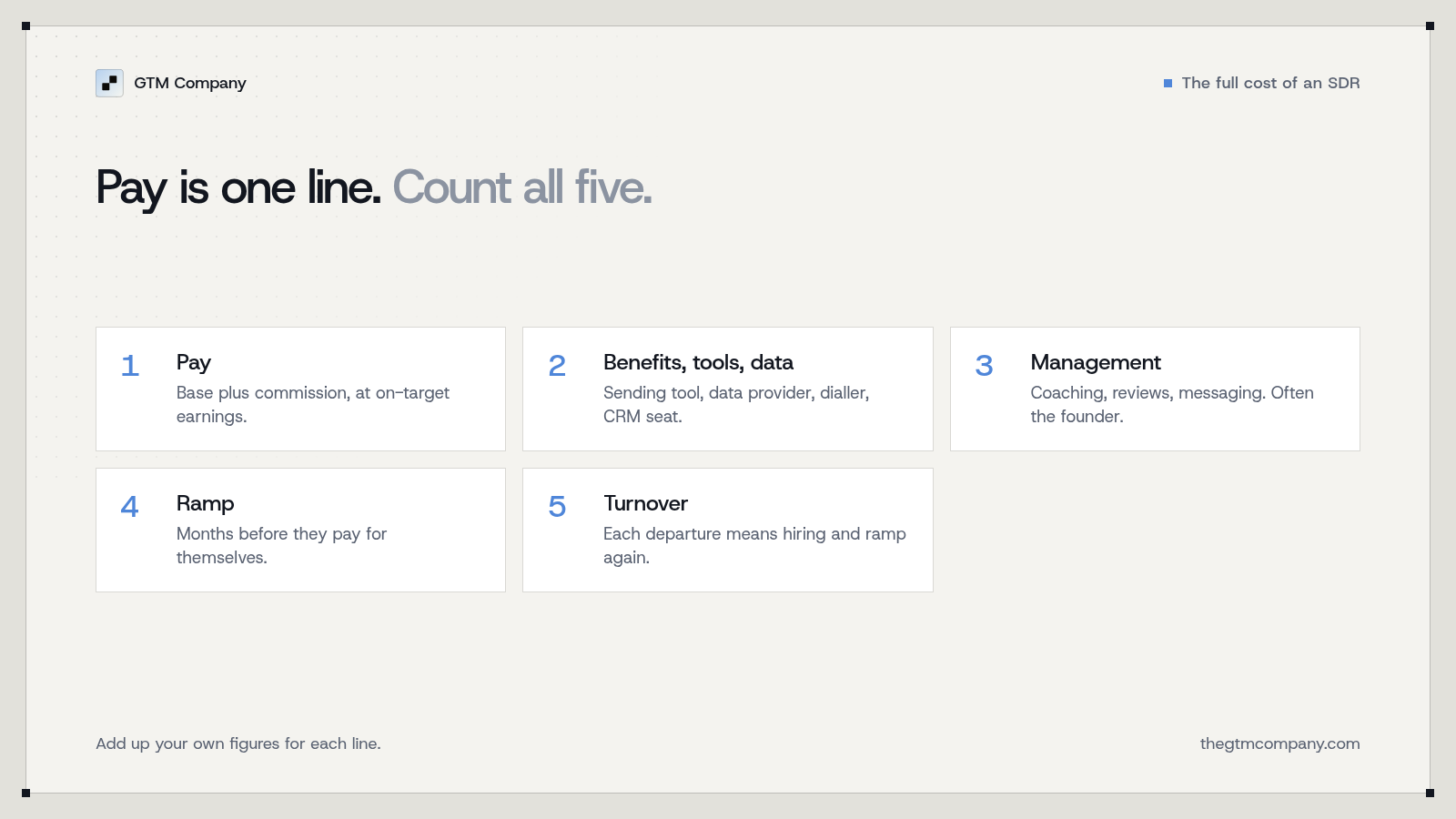
The salary is only part of it. When you work out the cost of an SDR, include:
- Pay. Base salary plus commission, at on-target earnings for your market and location.
- Benefits, tools and data. Sending tools, a data provider, a dialler and a CRM seat all sit on top of pay.
- Management. Somebody has to coach them, review their activity and write or approve their messaging. At an early-stage company, that's usually the founder.
- Ramp. The months before a new SDR is booking enough meetings to cover their cost.
- Turnover. SDR roles often turn over, and each time someone leaves, you pay for hiring and ramp again.
Put your own figures against each line and compare the total with any agency quote you have. Whichever comes out cheaper, the decision should rest on what you get, not on the monthly line item.
What an SDR needs to succeed
An SDR is very good at running a play. Give them a segment that responds, a message that books calls and a clear offer, and they'll work it hard every day.
What an SDR usually can't do, especially a junior one in their first months, is work out the play from scratch. Finding which segment, signal and message your market answers takes:
- research into your customers and competitors
- enough volume to read a test, which for cold email means tens of thousands of emails a month across many combinations
- the infrastructure to send that volume safely: separate domains, warm-up and inbox management
- someone senior enough to make a call each week about what to keep and what to cut
Ask an SDR to do all of that alone and you'll often get a busy person sending a message nobody has tested. The activity numbers will look fine. The pipeline won't.
I've seen what activity without a message looks like. One HR tech client had made 400 cold calls that booked a single meeting before they came to us. Nobody was short of effort. After we found the message, outbound produced $6M in pipeline in six months. Same market, same product, different words.
Before you write the job ad
If you're leaning towards hiring, answer these first. They'll shape the role, and they'll tell you whether you're ready.
- What will they say on day one? If you can't write the first email they'll send, they'll be writing it, and that's the search, not the run.
- Who will they sell to? A named segment with a reason to buy now, not "mid-market SaaS".
- What's a good week? Positive replies and meetings, based on something you've seen, not an industry average.
- Who coaches them? Name the person and the hour in the week.
- What happens if they leave? Where will the lists, the sequences and the learning live?
If those answers are clear, the job ad almost writes itself. If they aren't, that's a sign to find the message first and hire second.
The order matters
This is the point I'd make to any founder weighing it up. Hire the SDR after you have a message to give them.
If you hire first, the SDR spends their ramp period, and maybe their tenure, searching for the message. If the search fails, it can look like the SDR failed, and you're back to hiring.
If you find the message first, the SDR starts with a play that's already been shown to work. Their ramp should be shorter, because they're learning to run a play that already exists. You can also judge their performance fairly, because you know what the message does when it's run well.
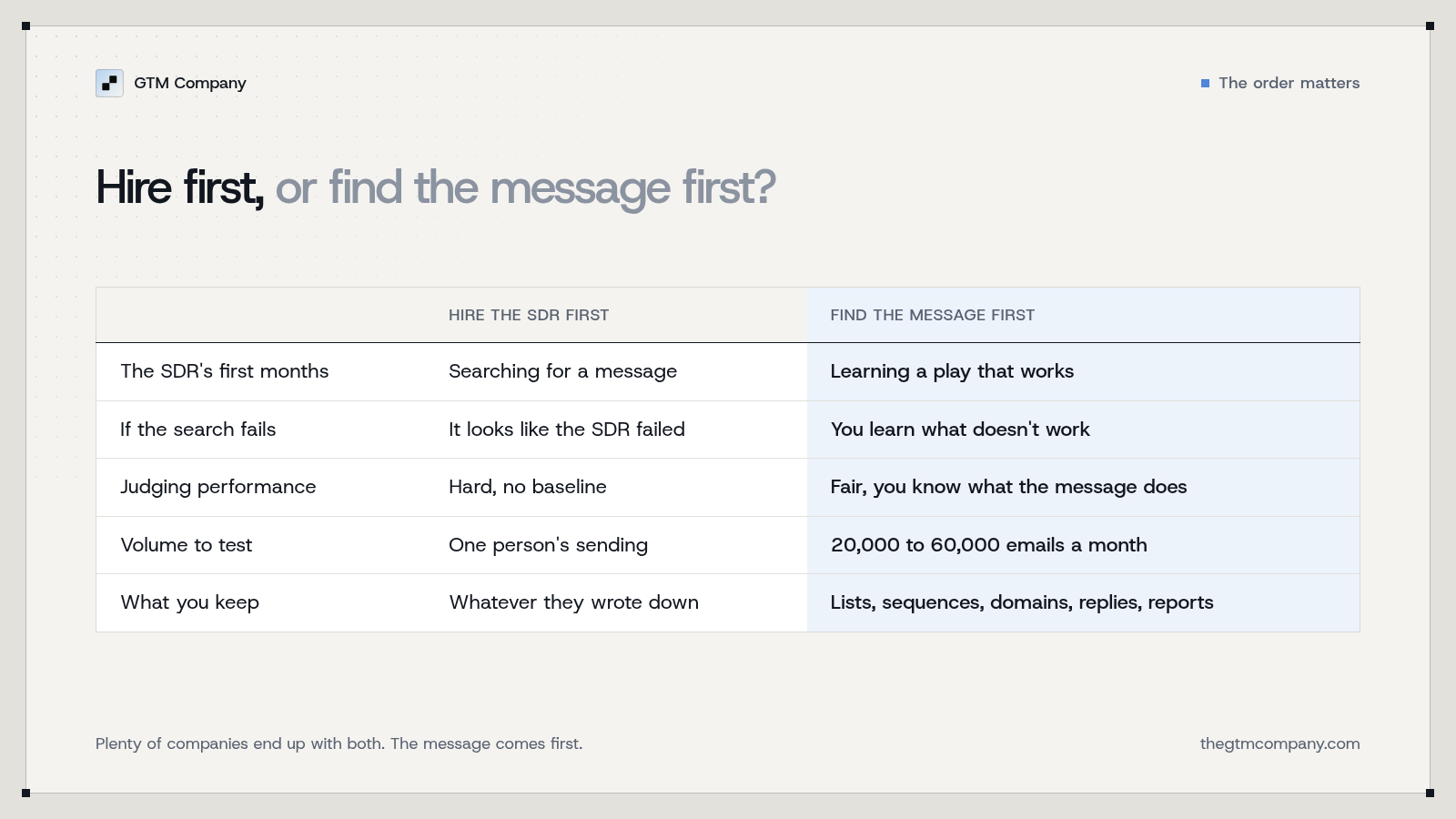
| Hire the SDR first | Find the message first | |
|---|---|---|
| The SDR's first months | Searching for a message | Learning a play that works |
| If the search fails | It looks like the SDR failed | You learn what doesn't work, cheaply |
| Judging performance | Hard, no baseline | Fair, you know what the message does |
| Volume to test | One person's sending | 20,000 to 60,000 emails a month |
| What you keep | Whatever they wrote down | Lists, sequences, domains, replies, reports |
A worked example of the two routes
This is an example, not a client story. Two founders with the same product and market each have budget for one bet this year.
The first hires an SDR in January. The SDR spends February learning the product, builds a list and writes a sequence in March, and by May has booked a handful of meetings, few of which close. Nobody can say whether the problem is the segment, the message or the SDR. In June the founder starts wondering whether to replace them.
The second spends the first three months finding the message. By April there's a combination that repeats across 10,000 emails, a written record of what was tested and why, and a segment the founder trusts. The SDR hired then starts with a play that works, a target based on real numbers, and a manager who knows what good looks like.
Both founders spend money. Only the second knows, by mid-year, what they're buying more of.
There are cases where an SDR makes sense straight away:
- You already have a proven outbound message. A segment that books calls at a known rate, and a founder or sales lead who can hand it over.
- Your outbound is mostly phone or account-based. For a small number of large accounts, a person working each one closely can beat email at scale.
- You have someone to manage them. A sales leader with outbound experience who can coach, review and adjust.
If those are true, hire. An agency focused on finding the message is solving a problem you don't have.
When to find the message first
Find the message before you hire when:
- pipeline comes mostly from referrals and the founder's network
- what you've sent cold so far hasn't worked
- there's nobody to manage an SDR except the founder
- your market has enough companies to test properly (at least 5,000 target companies, ideally many more)
In that situation, a person on the payroll doesn't fix the underlying gap. The message does.
What to hand over to an SDR
If you find the message first, the handover is what makes the hire work. Give them:
- The winning combinations. Segment, signal and message, with the positive reply rate each one produced.
- The losers, and why they lost. So nobody re-tests them in month two.
- The reply library. Real positive replies and objections, and how each was answered.
- The lists and the list rules. Where the data comes from and how a company qualifies.
- The sending set-up. Domains, mailboxes and the daily limits that keep them healthy.
- The targets. Based on what the message has already done, not a guess.
Common mistakes when making the choice
Comparing salary with a retainer. Compare full cost, including ramp, tools, management and turnover, with what each option leaves you.
Hiring a junior SDR to find the message. Finding the message is research and judgement work. Running it is where SDRs shine.
Assuming the founder can manage them part time. If the founder is also the main closer, coaching usually slips first.
Judging the SDR without a baseline. If you don't know what a good message produces, you can't tell whether a low number is the person or the play.
It isn't always one or the other
Plenty of companies end up with both. The message comes first, then a person to run it alongside or after the email programme.
What it looks like without a new hire
An AI accounting technology client grew from $30k to $350k MRR in six months, booking 20 or more demos a month, without a new sales hire. That won't be true for every company, but it shows what a tested message can do before headcount is added.
A quick way to decide
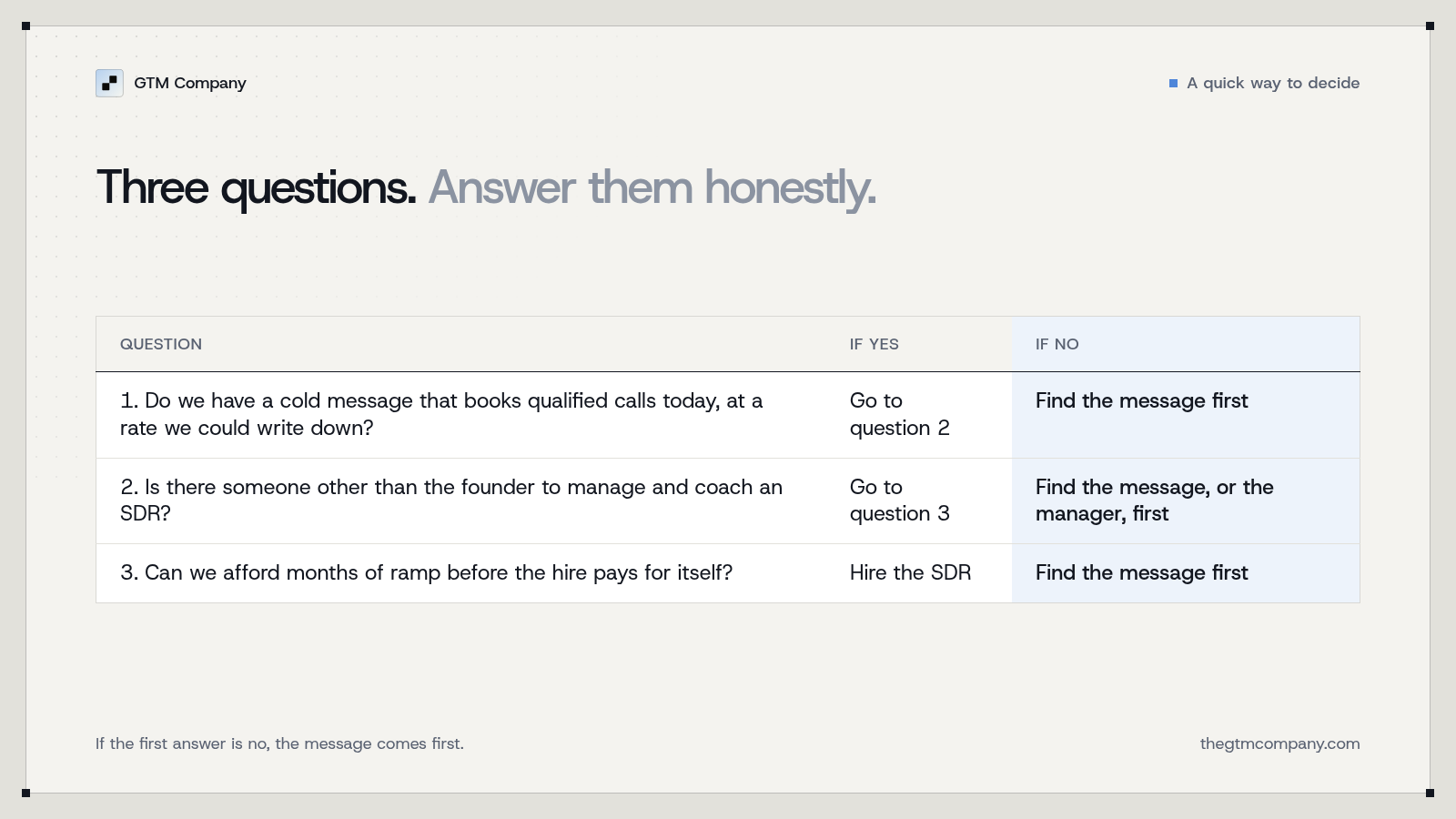
Answer these three questions honestly:
- Do we have a cold message that books qualified calls today, at a rate we could write down?
- Is there someone other than the founder who can manage and coach an SDR?
- Can we afford the ramp period before the hire pays for themselves?
If the answer to all three is yes, hire the SDR. If the first answer is no, find the message first. If you're also considering running it all yourself, running cold email in-house covers that option.
FAQ
Is an SDR cheaper than an agency? It depends on your figures. Count the full cost, not only the salary, and compare it with the agency quote. But cost isn't the deciding factor. The order is.
Can an SDR and an agency work together? Yes. The agency finds and proves the message, and the SDR runs it, often on calls and LinkedIn alongside email.
What about an experienced SDR, not a junior one? A senior SDR can do more of the search, but they still need the volume, the infrastructure and the time. Ask how they'd test 10 to 15 combinations on their own, and how long it would take at their sending pace.
Do we need an SDR at all? Not always. Some companies grow from a tested email programme without a new sales hire.
How long does finding the message take? Our first stage runs three months. If we haven't found a winner by then, we keep going at no cost.
If you'd like to talk it through with your numbers, book a call at thegtmcompany.com. If an SDR is the better choice for you, we'll say so.